
Sanjay Kumar Mohindroo
A seven-question executive alignment scorecard to test business outcomes, capital discipline, accountability, and risk before technology investment.
The Executive Alignment Scorecard I Use Before Technology Gets Funded
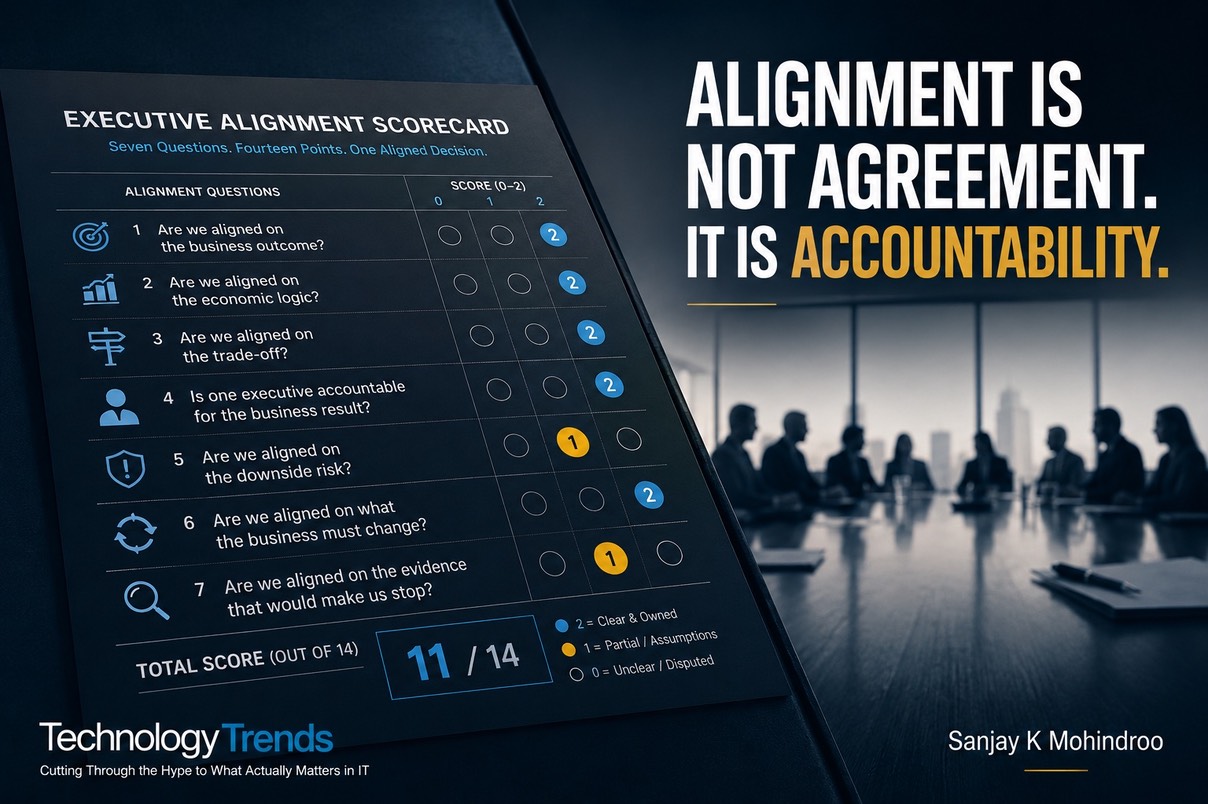
Seven questions. Fourteen points. Less than 11, and I would hesitate before committing serious capital.
That may sound harsh. But after decades of sitting in executive meetings where everyone appeared to agree, I have learned that agreement is one of the weakest tests of alignment.
The conventional wisdom says that if the CEO, business leaders, technology team and finance team are all supportive of an initiative, the organisation is aligned.
I disagree.
I have seen rooms full of intelligent executives nod to the same proposal while carrying completely different assumptions about what success meant, how much disruption was acceptable, who owned the result, and when the organisation should stop spending.
That is not alignment.
It is deferred disagreement.
And deferred disagreement becomes expensive once contracts are signed, teams are mobilised and reputations are attached to the programme.
Why Business and IT Alignment Is Usually Tested Too Late
Most organisations test alignment through governance.
There is a steering committee. There is an investment paper. There is a programme sponsor. There are status reports, risk registers and quarterly reviews.
All useful.
But governance begins after one more important question should already have been answered:
Are the executives actually aligned on the decision they are making?
This distinction matters.
A project can have excellent governance and still be solving the wrong problem.
A transformation can be on schedule and still fail to create enough economic value.
A technology investment can meet every technical milestone while the operating business quietly avoids changing the processes required to capture the benefit.
By the time those problems become visible in a steering committee, the organisation may already have committed millions.
This is why I prefer to test alignment before debating architecture, vendors or detailed delivery plans.
The test I use is deliberately simple.
Seven questions.
Each receives a score from 0 to 2.
0 means unclear or disputed.
1 means partially defined or dependent on assumptions.
2 means explicit, measurable and owned.
The maximum score is 14.
The mathematics is not the point. The conversation behind the score is.
The 7-Part Executive Alignment Scorecard
1. Are we aligned on the business outcome?
The first question should never be, “What technology are we implementing?”
It should be:
What business result will be materially different if this works?
A score of 0 means the answer is largely technological: migrate the platform, deploy AI, modernise the core, move to cloud.
A score of 1 means there is a business aspiration, but it remains broad: improve customer experience, increase productivity, enable growth.
A score of 2 requires a business outcome that executives can recognise and measure.
Reduce customer onboarding from twelve days to four.
Lower cost-to-serve by 15 percent.
Release enough working capital to fund expansion without increasing borrowing.
Increase conversion in a strategically important customer segment.
The wording changes by industry. The principle does not.
Technology is not the outcome.
If the executive team cannot state the business consequence clearly, everything that follows is built on weak foundations.
2. Are we aligned on the economic logic?
This is where many apparently strategic programmes become uncomfortable.
Boards are often shown the cost of an initiative and an estimate of its benefits. That is not the same as understanding its economic logic.
I want executives to answer three things:
Where does the value come from?
When should it become visible?
What has to be true for that value to materialise?
The last question is particularly important.
A system may create the capability to reduce operating cost. It does not automatically reduce operating cost.
A new digital channel may create the ability to serve customers more efficiently. Unless volumes migrate, processes change and legacy costs are removed, the economic benefit may never appear.
A score of 2 therefore requires more than a business case spreadsheet.
It requires agreement on the mechanism through which capital becomes business value.
That is a very different conversation.
Capital Allocation Is an Alignment Test
Technology portfolios have a peculiar habit.
Almost everything becomes “strategic”.
Once that label is attached, normal capital discipline can weaken.
I challenge that.
If an initiative is genuinely strategic, executives should be able to explain why it deserves scarce capital ahead of another credible investment.
Which brings me to the third question.
3. Are we aligned on the trade-off?
Every serious investment consumes more than money.
It consumes management attention, organisational capacity, specialist talent and the willingness of employees to absorb change.
So, I ask:
What are we choosing not to do because we are doing this?
If the answer is “nothing”, I become concerned.
Executives often treat prioritisation as deciding which projects are important.
Real prioritisation is deciding which important projects will not happen now.
A portfolio containing 25 “top priorities” is not a prioritised portfolio.
It is a queue.
A score of 2 requires an explicit trade-off.
This initiative receives funding, people and executive attention. Something else is deferred, reduced or stopped.
That is when strategy starts becoming real.
4. Is one executive accountable for the business result?
Technology programmes often have sponsors.
That does not necessarily mean they have owners.
The distinction is critical.
A sponsor can support the programme, remove obstacles and attend governance meetings.
An owner is accountable for the business result.
I look for one named executive who can answer:
If the expected outcome does not materialise, who must explain why?
Not the CIO and the business collectively.
Not a transformation committee.
Not “the programme”.
One executive.
This does not mean that technology leadership escapes accountability. Far from it. The CIO remains accountable for technology choices, execution quality, resilience, security and technology economics.
But if the programme is justified by a business outcome, someone in the business must own that outcome.
Shared accountability too easily becomes diluted accountability.
5. Are we aligned on the downside risk?
Transformation proposals naturally emphasise upside.
Boards need to spend more time on downside.
What happens if implementation takes twelve months longer?
What happens if adoption reaches only 40 percent?
What happens if the new platform increases dependency on one strategic supplier?
What happens if the expected cost reduction requires restructuring that the organisation later decides not to undertake?
What happens if the initiative succeeds technically but fails commercially?
A score of 2 does not mean the risks are small.
It means the executive team understands the material risks, has consciously accepted them, and knows who owns each one.
There is an important difference between a known risk and an owned risk.
Risk registers capture the first.
Leadership creates the second.
Digital Transformation Fails Outside the Technology Function
The next question is the one I have found most revealing.
6. Are we aligned on what the business must change?
Many technology programmes are presented as if value will emerge from implementation.
It rarely does.
Value appears when behaviour changes.
Processes change.
Decision rights change.
Roles change.
Customer journeys change.
Incentives sometimes change.
Legacy activities stop.
An organisation can install a world-class platform and preserve the old operating model around it. When that happens, the new technology often becomes an expensive wrapper around yesterday's business.
A score of 2 therefore requires the business executives to articulate what they themselves will change.
Not what IT will deliver.
What the business will do differently.
This question also exposes one of the most common forms of false alignment.
Executives may enthusiastically support transformation in principle while resisting the organisational consequences required to make it economically worthwhile.
That contradiction needs to surface before the investment is approved, not eighteen months later.
7. Are we aligned on the evidence that would make us stop?
This is the question most executive teams initially dislike.
Under what circumstances would we reduce, redesign or stop this programme?
The usual answer is some version of: “We are committed to making it succeed.”
That sounds decisive. It is also dangerous.
Commitment is useful in execution.
It is dangerous when it prevents leaders from responding to evidence.
Every major initiative should have predefined signals that tell the executive team whether its assumptions remain valid.
Perhaps customer adoption must reach a certain threshold.
Perhaps an initial deployment must demonstrate a measurable productivity gain.
Perhaps costs must remain within a defined range.
Perhaps integration complexity reveals that the original economics no longer hold.
Whatever the measure, leaders should agree on it before sunk costs and reputational attachment distort the decision.
A score of 2 means executives know what evidence would cause them to continue, change course or stop.
That is not pessimism.
It is capital discipline.
How I Read the Executive Alignment Score
The total score creates three useful conversations.
11 to 14: Commit
The leadership team has enough clarity to make a serious capital decision.
There will still be uncertainty. Transformation always contains uncertainty.
But the outcome, economics, trade-offs, ownership, risk, organisational change and evidence thresholds are sufficiently explicit.
8 to 10: Resolve before scaling
This is where many programmes should pause.
Not stop.
Pause.
One or two important questions remain unresolved. Perhaps the technology case is strong but no business executive truly owns adoption. Perhaps the economics depend on cost reductions nobody has agreed to execute.
Those issues are cheaper to resolve in the boardroom than during implementation.
0 to 7: Reframe
At this level, I would question whether there is actually one initiative.
There may instead be several competing ideas hiding under one programme name.
The correct response is usually not better project management.
It is a better executive conversation.
An Illustrative Example: When Everyone Supports the Programme
Consider a multinational organisation debating a major customer platform investment.
Everyone supports it.
The CEO wants better customer experience.
Sales wants more leads.
Operations wants lower service costs.
Technology wants to simplify a fragmented application landscape.
Finance expects productivity improvement.
It sounds perfectly aligned.
Run the scorecard.
The desired outcome? Four different answers.
Economic logic? Benefits depend on customers moving from assisted to digital channels, but nobody owns that migration.
Trade-off? No existing programme is being stopped.
Accountability? The CIO is named sponsor, even though most of the benefits sit in sales and operations.
Risk? Technology risks are documented. Commercial adoption risk is not.
Business change? Existing service processes are expected to continue during an undefined transition period.
Stop rule? None.
The initiative can have unanimous support and still score poorly.
This is exactly why I do not use enthusiasm as a proxy for alignment.
A difficult twenty-minute conversation before approval can save months of difficult conversations after approval.
The Counter-Argument: Can Seven Questions Oversimplify Transformation?
Of course they can.
A large transformation may involve hundreds of decisions, multiple jurisdictions, several technology domains and thousands of employees.
No seven-question scorecard can capture that complexity.
Nor should it try.
Its purpose is not to manage the programme.
Its purpose is to test whether the leaders committing the organisation understand the same decision.
Complexity is often used as an argument for more detail.
At board level, complexity creates the opposite requirement.
Executives need sharper clarity about the few things that determine whether the investment deserves continued capital and attention.
The scorecard is therefore intentionally reductive.
If seven fundamental questions cannot be answered, another seventy slides will not create alignment.
What Boards Should Ask Before the Next Major Technology Decision
If I were advising a board reviewing a significant technology or transformation investment tomorrow, I would ask them to spend less time initially on the solution and more time on seven sentences:
1. The business outcome we are buying is...
2. The economic value will appear because...
3. To fund and execute this, we are choosing not to...
4. The executive accountable for the business result is...
5. The most material downside we are accepting is...
6. The business will have to change by...
7. We will reconsider the investment if the evidence shows...
If those sentences are clear, technology discussions become substantially better.
If they are not, the organisation is probably not ready to make the investment decision it thinks it is making.
Alignment Is Not Agreement
The conventional view of executive alignment places considerable value on consensus.
I place more value on clarity.
An aligned executive team does not need to agree on every detail.
It does need to agree on the outcome, economic logic, capital trade-off, accountability, risk, organisational consequences and evidence that will determine the next decision.
That definition is tougher.
It is also far more useful.
Because when conditions change, as they inevitably will, genuine alignment gives leaders a common basis for making the next decision.
Consensus merely tells you what everybody believed at the beginning.
How does your executive team test alignment before committing major technology capital, and which of these seven questions tends to expose the biggest gap?
If you value practical perspectives on technology, leadership, and enterprise decision-making, subscribe to TechnologyTrends or add your perspective in