
Sanjay Kumar Mohindroo
True fulfilment comes from balancing deep human connection with meaningful solitude.
Human beings often assume that personality must fit neatly into a category. We are either social or solitary. We either seek crowds or avoid them. Yet life rarely works in such simple ways.
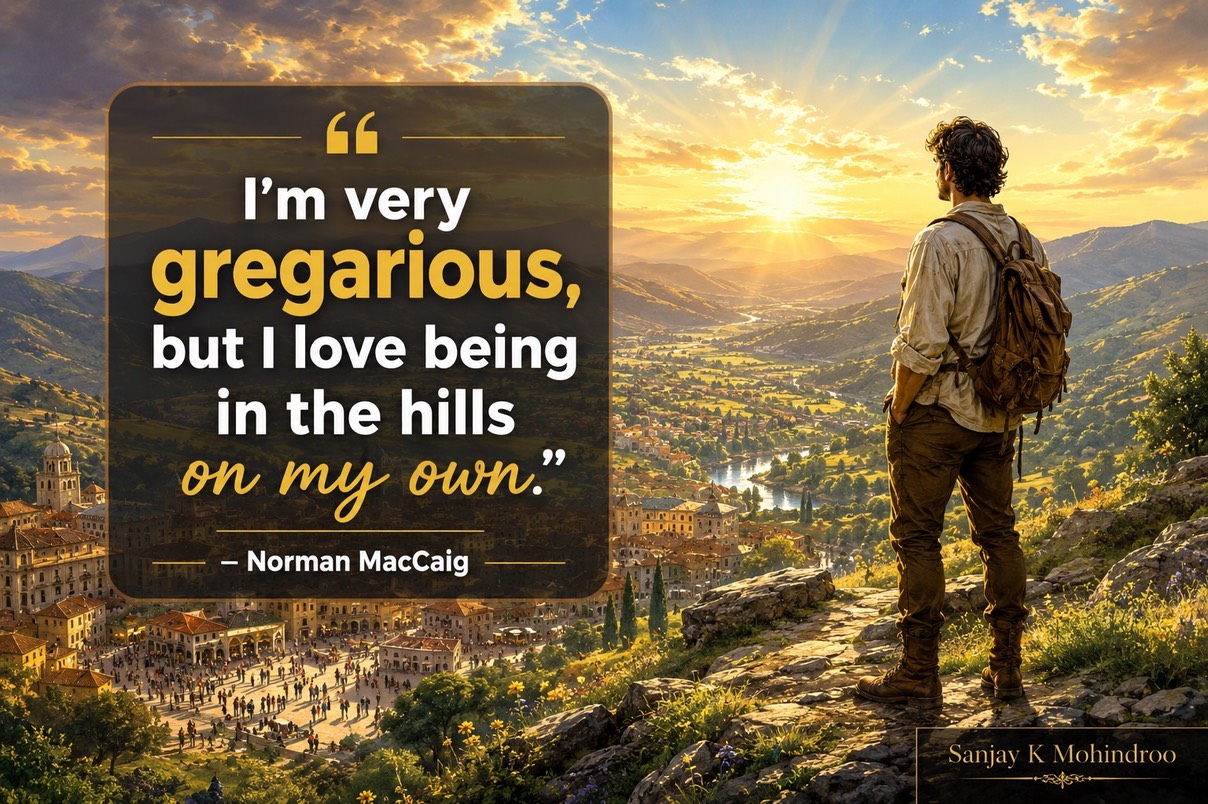
As Norman MacCaig once said, "I'm very gregarious, but I love being in the hills on my own."
At first glance, the statement feels contradictory. A social person enjoying complete solitude appears unusual. Yet the quote captures something deeply human. It reflects the tension many people feel between the need for connection and the need for space. It reminds us that enjoying people does not mean losing ourselves in them. It also suggests that solitude is not loneliness. It can be a source of clarity, strength, and renewal.
This idea matters more than ever. We live in a time where constant interaction is often celebrated, while time alone is misunderstood. MacCaig's words invite us to reconsider that assumption and explore the relationship between companionship and self-discovery.
The Human Need for Both Worlds
Connection Gives Energy, Solitude Gives Perspective
Most people gain something valuable from social interaction. Conversations spark ideas. Friendships provide comfort. Communities create a sense of belonging. Human connection remains one of the strongest influences on happiness and well-being.
Yet connection alone is not enough.
Many of life's most important insights emerge when there is nobody else around. Decisions become clearer. Emotions become easier to understand. Thoughts that are buried beneath noise finally rise to the surface.
This is where many people become confused. They assume solitude exists because social life is absent. In reality, healthy solitude serves a different purpose. It creates space for reflection. It allows the mind to settle and organize itself.
The strongest relationships often belong to people who are comfortable spending time alone. They do not depend on constant attention because they already possess a stable relationship with themselves.
In a culture driven by endless notifications and constant communication, choosing solitude can become an act of personal strength. It is a reminder that #SelfAwareness begins when external voices become quieter.
The Hills as a Symbol
Places That Allow the Mind to Breathe
MacCaig did not simply mention being alone. He mentioned being alone in the hills.
That detail matters.
For centuries, mountains, forests, and open landscapes have represented freedom, reflection, and perspective. When people stand before something larger than themselves, daily worries often shrink into proper proportion.
Nature strips away distractions. It removes deadlines, expectations, and social performances. It asks nothing except presence.
Many leaders, writers, artists, and thinkers have sought moments in nature for this exact reason. They understood that creativity often appears when pressure disappears. Answers arrive when the mind is no longer chasing them.
The hills become more than a location. They become a metaphor for stepping away from noise.
Everyone has their own version of the hills. For some, it is a quiet morning walk. For others, it is reading in silence, riding a motorcycle through open roads, or sitting beside a river without a schedule.
These moments create mental space. They remind us that #Mindfulness is not about escaping life. It is about seeing life more clearly.
The Hidden Cost of Constant Social Presence
When Connection Becomes Performance
Modern society rewards visibility.
People are encouraged to share opinions, document experiences, and remain constantly available. Social platforms make it easy to stay connected. Yet they also create pressure to remain connected all the time.
The result is subtle exhaustion.
Many people spend so much time responding to the world that they rarely pause to understand their own thoughts. They become experts at engagement but strangers to themselves.
This creates an important distinction.
Being surrounded by people does not automatically create fulfilment. In some cases, it creates distance from personal identity. The louder the environment becomes, the harder it can be to hear one's own voice.
Solitude acts as a reset button.
It allows individuals to reconnect with values, priorities, and aspirations that may have become buried beneath expectations. It helps separate personal truth from public performance.
That process strengthens #PersonalGrowth by creating alignment between who we are and how we live.
The Confidence to Enjoy One's Own Company
A Quiet Form of Freedom
Many people fear being alone because solitude forces honesty.
Without distractions, there is nowhere to hide from doubts, ambitions, regrets, or dreams. Yet this discomfort often becomes the starting point for growth.
People who enjoy their own company possess a unique form of freedom. They are less dependent on external validation. They make decisions based on conviction rather than approval. They are able to enter social situations because they want to, not because they need to.
This balance creates emotional independence.
Interestingly, those who value solitude often become better companions. Their conversations carry depth. Their attention becomes more genuine. Their relationships become more meaningful because they are built on choice rather than dependency.
The ability to stand comfortably in silence often produces stronger communication than endless conversation.
That is one reason #Leadership and personal influence frequently begin with self-understanding.
The Balance That Creates a Rich Life
Neither Isolation nor Constant Engagement
The deeper message behind MacCaig's observation is balance.
Life does not require choosing between people and solitude. It asks us to appreciate both.
Relationships enrich experience. Solitude deepens understanding.
One expands our perspective through others. The other expands our perspective through ourselves.
A meaningful life often emerges from moving between these worlds with intention. We engage fully when with others. We reflect deeply when alone. We contribute to communities while preserving space for personal growth.
This rhythm creates emotional stability. It prevents burnout. It encourages creativity. Most importantly, it allows individuals to remain connected without becoming consumed.
In a noisy world, the ability to move comfortably between conversation and quiet reflection may be one of the most valuable skills a person can develop.
Norman MacCaig's observation captures a truth that many people spend years discovering. Human connection and solitude are not opposing forces. They are partners.
The conversations we have with others shape our understanding of the world. The conversations we have with ourselves shape our understanding of who we are.
A life filled only with crowds can feel empty. A life filled only with isolation can feel incomplete. The richest path lies between them.
The goal is not to escape people. The goal is not to avoid solitude. The goal is to value both enough to know when each is needed.
That balance creates clarity, confidence, and a deeper appreciation for life itself.
#SelfAwareness #Mindfulness #PersonalGrowth #Leadership #Reflection #HumanConnection #EmotionalIntelligence #GrowthMindset
Norman MacCaig was a celebrated Scottish poet known for his vivid observations of people, landscapes, and everyday life. His writing often explored the relationship between human experience and the natural world. His reflections continue to resonate because they combine simplicity with profound insight.