
Cataloguing Strategic Innovations and Publications
IT Leadership in Healthcare.

Sanjay Kumar Mohindroo
How IT leadership is transforming healthcare through data-driven patient care and strategic digital transformation.
Enabling Data-Driven Patient Care
Healthcare does not suffer from a lack of data. It suffers from a lack of clarity.
Every hospital board I
speak to asks the same question in different ways:
We have invested millions in systems, platforms, dashboards, and analytics. Why
does patient care still feel reactive?
The uncomfortable answer is this. Technology alone does not transform healthcare. Leadership does.
Data-driven patient care is not about deploying another analytics tool. It is about reshaping how decisions are made across clinical, operational, and financial domains. It demands digital transformation leadership at the highest level. It requires courage to rethink workflows. And it forces CIO priorities to shift from uptime and cost control to clinical impact and measurable outcomes.
If we treat IT as a support function, healthcare remains fragmented.
If we treat IT as a strategic enabler, healthcare becomes predictive,
coordinated, and patient-centered.
This is a boardroom conversation. Not a server room one.
Healthcare margins are tightening. Regulations are expanding. Patient expectations are rising. Talent shortages are worsening.
In this environment, data is not an asset. It is leverage.
Boards now evaluate hospitals and health systems on measurable outcomes, patient satisfaction, operational efficiency, and compliance strength. All of these depend on structured, reliable, and actionable data.
Poor data governance creates risk.
Fragmented systems create blind spots.
Slow insights create delays in care.
Every delayed insight is a delayed intervention.
From a business perspective, the impact is clear:
First, financial performance. Predictive analytics can reduce readmissions, optimize staffing, and improve bed utilization. That directly affects revenue and cost control.
Second, risk exposure. Cybersecurity in healthcare is not theoretical. A single breach can shut down operations and damage trust for years. Digital transformation leadership must treat resilience as a clinical necessity, not an IT feature.
Third, competitive advantage. Patients increasingly choose providers based on digital experience. Appointment scheduling, access to records, telehealth, and AI-supported triage. These are no longer add-ons. They shape reputation.
Healthcare CEOs are
starting to ask a new question.
Is our emerging technology strategy improving patient outcomes, or is it just
modernizing infrastructure?
That question changes everything.
Key Trends Shaping the Landscape
Several shifts are redefining IT operating model evolution in healthcare.
1. From retrospective to predictive care
Healthcare data was historically used for reporting. Now it is being used for forecasting. Machine learning models flag high-risk patients before deterioration. AI assists in diagnostics. Remote monitoring feeds continuous streams of patient data into decision engines.
But predictive capability only works if data is clean, integrated, and trusted.
2. Interoperability as a strategic imperative
Hospitals operate across multiple EMRs, lab systems, imaging platforms, and insurance portals. Without integration, insights remain trapped in silos. Interoperability is not a compliance checkbox. It is the backbone of coordinated care.
Leaders who treat interoperability as a capital expense miss the point. It is a clinical multiplier.
3. Rise of real-time decision intelligence
Clinicians do not have time to interpret complex dashboards. They need embedded insights within workflows. Alerts must be meaningful. Recommendations must be explainable.
Data-driven decision-making in IT now demands design thinking. Insight delivery matters as much as insight generation.
4. AI governance and ethical oversight
AI in healthcare carries risk. Bias in training data can lead to unequal care. Overreliance on automation can erode clinical judgment. Leaders must build guardrails. Ethical AI is a leadership discipline.
5. Cybersecurity as patient safety
A ransomware attack in healthcare is not just a financial event. It can disrupt surgeries, delay treatments, and compromise lives. CIO priorities now place resilience and zero-trust architecture alongside innovation.
These trends are not theoretical. They are reshaping how care is delivered daily.
What Works and What Fails
Over the years, I have seen patterns emerge.
Technology without clinical alignment fails.
Many digital initiatives begin in IT and struggle with adoption. Why? Because clinicians were not part of the design conversation. Healthcare transformation must be co-created with doctors, nurses, and administrators.
If clinicians see
technology as extra work, the system fails.
If they see it as decision support, adoption accelerates.
Data quality is a leadership issue, not a technical one.
Executives often underestimate the effort required to standardize and govern data. Without strong executive sponsorship, data quality programs stall.
When the CEO asks for data lineage and auditability in board meetings, the organization pays attention.
Culture determines success.
Data transparency can expose performance gaps. That creates discomfort. Leaders must foster a culture where metrics drive improvement, not blame.
The shift from hierarchy-based decisions to evidence-based decisions is cultural. Not technical.
What leaders often miss is this.
Digital transformation leadership in healthcare is less about systems and more about trust. Trust in data. Trust in governance. Trust between clinical and IT teams.
A Practical Framework: The CARE Model
For leaders seeking clarity, I use a simple framework called CARE.
C – Clinical Alignment
Start with patient outcomes. Map every technology initiative to a measurable clinical metric. Reduced infection rates. Faster discharge times. Lower readmission risk.
A – Architecture and Interoperability
Create a unified data architecture. Invest in APIs, integration layers, and master data governance. Avoid vendor lock-in that limits flexibility.
R – Risk and Resilience
Embed cybersecurity, compliance, and AI governance into the operating model. Conduct regular resilience simulations. Treat downtime as a clinical emergency.
E – Experience
Focus on user experience for clinicians and patients. Simplify interfaces. Deliver insights in context. Reduce cognitive load.
This framework keeps digital initiatives grounded in impact.
It also supports IT operating model evolution. As healthcare scales, centralized governance must balance with decentralized agility. Platform thinking replaces project thinking.
Case Studies in Action
Predictive sepsis detection
A mid-sized hospital integrated lab results, vital signs, and historical patient data into a predictive model. The system generated early alerts for sepsis risk. Mortality rates declined. Length of stay improved. But the real breakthrough came from workflow integration. Alerts were embedded directly into clinician dashboards with clear action pathways.
Lesson. Technology must fit the workflow.
AI-supported radiology triage
A regional health system deployed AI to prioritize urgent scans. Radiologists received flagged cases first. Turnaround times for critical diagnoses improved significantly.
Lesson. AI augments expertise. It does not replace it.
Cyber resilience overhaul
After a near-miss ransomware incident, a large hospital group redesigned its security posture. They implemented network segmentation, zero-trust access, and regular crisis drills. When a later attack attempt occurred, operations continued with minimal disruption.
Lesson. Preparedness saves more than money.
These examples highlight a pattern. Emerging technology strategy must align with operational realities.
The Future of Healthcare IT Leadership
The next five years will redefine the CIO role in healthcare.
CIOs will become outcome officers.
CDOs will become trust architects.
CTOs will shape platform ecosystems rather than infrastructure stacks.
Generative AI will assist documentation and administrative processes. Wearables will feed continuous patient data streams. Genomic analytics will personalize treatment pathways. None of these matters without strong governance and ethical oversight.
The board will expect measurable ROI.
Patients will expect seamless digital journeys.
Regulators will expect transparency and accountability.
Healthcare IT leaders must respond with clarity.
First, elevate data governance to the board agenda.
Second, invest in
talent who understand both technology and clinical workflows.
Third, redesign operating models to support agility and resilience.
This is not an incremental change. It is a structural transformation.
The organizations that succeed will not be those with the most advanced tools. They will be those with the clearest leadership vision.
Healthcare stands at a crossroads.
We can continue layering new systems on legacy complexity. Or we can rethink how data flows, how decisions are made, and how leadership shapes outcomes.
Data-driven patient care is not a slogan. It is a leadership mandate.
For those leading digital transformation in healthcare, I invite you to reflect:
Are your investments improving clinical decisions in real time?
Is your IT operating model built for resilience and innovation?
Are your teams aligned around patient outcomes or system upgrades?
The answers will define the next decade of healthcare.
Let us move beyond digital adoption and toward digital impact.
#DigitalTransformationLeadership #HealthcareIT #DataDrivenDecisionMakingInIT #CIOPriorities #EmergingTechnologyStrategy #ITOperatingModelEvolution #HealthcareInnovation #BoardLeadership
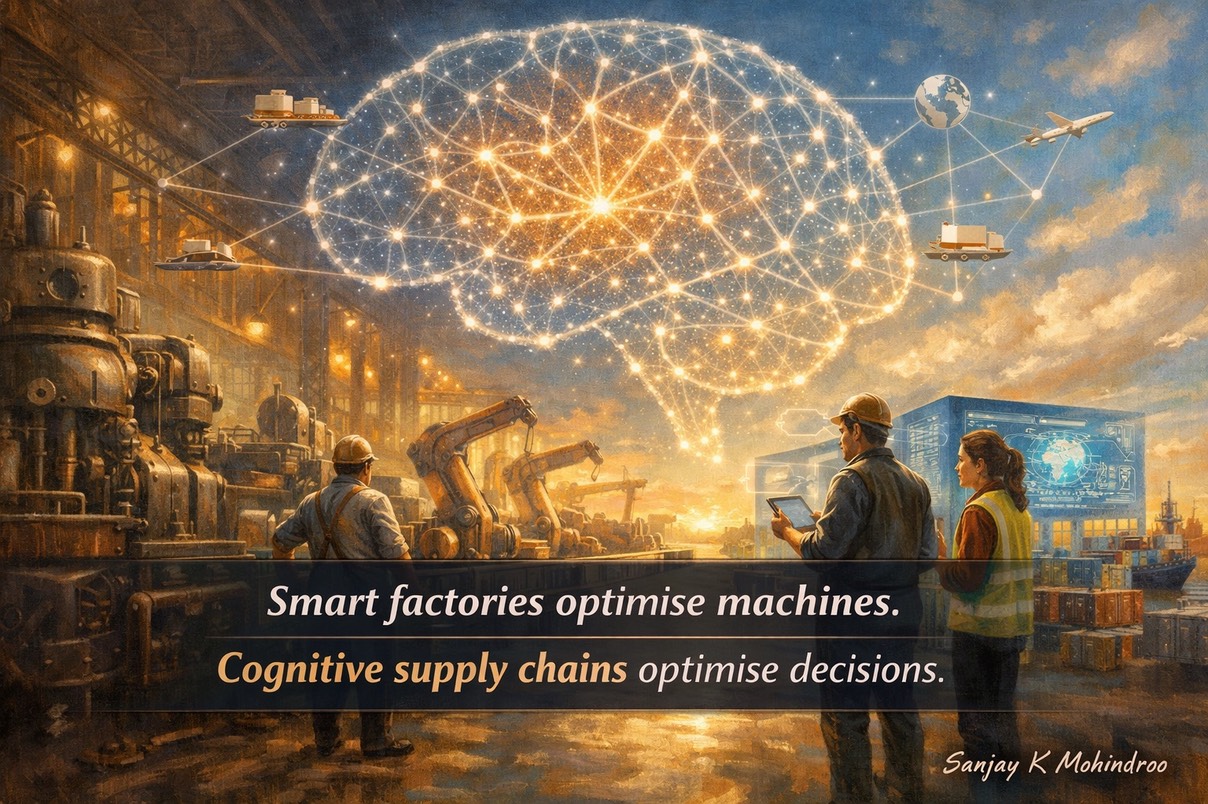
From Smart Factories to Cognitive Supply Chains.
Sanjay Kumar Mohindroo
IT is reshaping manufacturing from smart factories to cognitive, AI-driven supply chains.
Walk into most boardrooms today, and you will hear confident talk about smart factories. Sensors on machines. Real-time dashboards. Predictive maintenance. Automated quality checks.
It sounds impressive. It looks modern.
But here is the uncomfortable truth.
Many organizations have built digital factories without building digital thinking.
As someone who has spent years working at the intersection of operations and technology, I have seen a clear pattern. The companies that win are not the ones with the most robots. They are the ones where IT is woven into strategy, supply chains, capital allocation, and risk management.
Smart factories are only the starting point. The real transformation lies in building cognitive supply chains that learn, adapt, and make decisions at scale.
This is not a technology project. It is a leadership shift.
And it is redefining Digital transformation leadership across manufacturing.
A Boardroom Conversation
Manufacturing is no longer a cost efficiency game alone. It is a resilience game. A speed game. A data game.
Boards are asking sharper questions:
How exposed are we to geopolitical shocks?
How quickly can we reconfigure production?
Do we see demand signals early enough?
Are we allocating capital based on real operational intelligence?
These are not IT department questions. These are CEO and board-level concerns.
A modern manufacturing enterprise runs on three core assets: physical infrastructure, human capability, and digital intelligence.
If digital intelligence is fragmented, decisions slow down. If data is delayed, inventory rises. If supply chain signals are weak, working capital gets locked.
This is where IT operating model evolution becomes critical.
IT can no longer sit behind ERP maintenance. It must sit beside the COO and shape how production, logistics, procurement, and customer demand connect in real time.
That is why CIO priorities in manufacturing are shifting from system uptime to business impact.
This is also where competitive advantage now lives.
From Smart Factories to Cognitive Systems
Let us break the myth.
A smart factory focuses on optimizing what happens within four walls.
A cognitive supply chain focuses on optimizing what happens across the ecosystem.
There is a difference.
Smart factories use IoT, automation, robotics, and MES platforms to improve throughput and reduce downtime.
Cognitive supply chains use AI, advanced analytics, digital twins, and real-time data orchestration to anticipate disruption and self-correct.
One reacts faster.
The other thinks ahead.
We are now seeing five major shifts shaping this landscape:
1. Data as a Core Production Asset
Data is no longer a reporting tool. It is a production input.
When machine data connects with supplier data and customer demand signals, decisions improve across planning, sourcing, and fulfilment.
Leaders who treat data as infrastructure outperform those who treat it as a byproduct.
This is where data-driven decision-making in IT becomes a board capability.
2. Predictive to Prescriptive
Predictive maintenance is common. Prescriptive supply chain planning is still rare.
AI models can now recommend production reallocation when supplier lead times shift. They can simulate logistics bottlenecks before they hit revenue.
The technology exists. The question is whether governance and trust exist.
3. Edge Intelligence
Latency kills value in manufacturing.
Edge computing is pushing analytics closer to machines. That reduces downtime decisions from hours to seconds.
The impact is operational and financial.
4. Digital Twins at Scale
Digital twins are moving from pilot projects to enterprise models.
When you simulate an entire supply network before making a sourcing decision, risk management changes.
This is an emerging technology strategy in action.
5. Platform Thinking
Manufacturing ecosystems are becoming platforms.
Suppliers, logistics partners, distributors, and customers share structured data.
The enterprise becomes less linear and more networked.
What Works and What Fails
Over the years, I have observed three recurring lessons.
1. Technology Without Process Redesign Fails
Many organizations invest in advanced analytics but retain legacy planning cycles.
If your S and OP cycle remains manual and spreadsheet-driven, adding AI does not fix it.
Transformation requires rethinking decision rights, accountability, and data flows.
IT cannot drive this alone. It needs operational ownership.
2. Data Quality Is a Cultural Issue
Leaders often underestimate this.
You can deploy the best analytics platform, but if plant managers do not trust the numbers, decisions revert to instinct.
Building trust in data takes time. It requires transparency and clear metrics.
This is where Digital transformation leadership becomes visible. Leaders must role model data-based decision-making.
3. Cyber Risk Expands with Connectivity
Smart factories increase attack surfaces.
Operational technology and IT convergence create new vulnerabilities.
Boards must view cybersecurity as operational resilience, not just compliance.
Manufacturing downtime due to cyber events is a revenue issue.
A Practical Framework: The 5-Layer Cognitive Manufacturing Model
For leaders asking, where do we begin, here is a simple model I use in board discussions.
Layer 1: Connected Assets
Are your machines, warehouses,
and transport nodes connected in real time?
If not, start here.
Layer 2: Unified Data Architecture
Is operational data
integrated across ERP, MES, and supply chain systems?
Fragmented data kills intelligence.
Layer 3: Advanced Analytics and AI
Do you move beyond reporting into forecasting and scenario simulation?
Layer 4: Decision Automation
Where can decisions be automated with guardrails?
Example: auto-adjust production schedules based on supplier signals.
Layer 5: Governance and Culture
Do leaders trust digital recommendations?
Is accountability aligned with digital workflows?
If one layer is weak, the system underperforms.
This checklist often reveals gaps quickly.
Case Snapshot: Automotive Manufacturer
A global automotive company invested heavily in robotics and smart assembly lines.
Productivity improved. Downtime reduced.
Yet inventory remained high, and margins were volatile.
The issue was not factory efficiency. It was a demand signal integration.
Once dealer data, market analytics, and supplier lead times were integrated into a unified platform, production planning became dynamic.
Inventory days reduced by double digits.
The breakthrough did not come from better robots. It came from better data orchestration.
Case Snapshot: Consumer Goods Manufacturer
A consumer goods company faced frequent stockouts during seasonal peaks.
They implemented a digital twin of their supply network.
Before committing to production volumes, they ran multiple disruption scenarios.
The result was improved service levels and lower emergency freight costs.
The lesson was clear.
Visibility changes behavior.
What Is Coming Next
The next five years will reshape manufacturing IT in three major ways.
Autonomous Planning Systems
AI agents will handle baseline planning. Humans will focus on exceptions and strategy.
Sustainability Intelligence
Carbon tracking will integrate into supply chain systems.
Procurement decisions will factor in emissions, not just cost.
This will influence board metrics.
Human-Machine Collaboration
Operators will work alongside AI copilots that provide contextual recommendations in real time.
The CIO role will evolve further.
It will move from system custodian to digital business architect.
Emerging technology strategy will sit at the core of enterprise planning.
What Leaders Should Do Now
1. Treat IT strategy as an enterprise strategy.
2. Invest in data architecture before investing in advanced AI tools.
3. Redesign operating models to support digital decision-making.
4. Align incentives with digital outcomes.
5. Build cross-functional governance that connects IT and operations deeply.
The question is not whether manufacturing will become cognitive.
It will.
The question is whether leadership moves fast enough to shape it.
If you are a CEO, COO, CIO, or board member, ask yourself:
Is your digital roadmap improving visibility across the ecosystem?
Are decisions accelerating?
Is risk becoming more predictable?
Or are you only modernizing the factory floor?
Smart factories were the first chapter.
Cognitive supply chains are the next.
The organizations that understand this shift will not just operate efficiently. They will operate intelligently.
Let us move the conversation beyond automation.
Let us talk about intelligence.
I would love to hear how your organization is approaching this shift. What is working? What is proving harder than expected?
#DigitalTransformationLeadership #ManufacturingIT #CIOPriorities #EmergingTechnologyStrategy #ITOperatingModel #CognitiveSupplyChain #DataDrivenLeadership #Industry40
Digital Ethics Boards: Building Ethical Guardrails in IT.

Sanjay Kumar Mohindroo
Why Digital Ethics Boards are becoming essential guardrails in modern IT leadership.
Every major digital transformation I have seen begins with ambition.
Scale the platform.
Automate the workflow.
Deploy AI.
Monetize data.
Very few begin with a harder question.
Should we?
As technology leaders, we operate at the intersection of innovation and consequence. Our systems influence hiring decisions, credit approvals, medical diagnostics, content visibility, customer pricing, and even public discourse. Yet in many organizations, ethical oversight remains reactive. Legal reviews happen late. Risk teams step in after an incident. The board hears about it when headlines appear.
This is no longer acceptable.
Digital Ethics Boards are emerging as structured, cross-functional forums that create ethical guardrails before harm occurs. They do not slow innovation. They sharpen it. They help leadership move fast without breaking trust.
For those leading Digital transformation leadership agendas, this is not a compliance add-on. It is a core governance capability.
Ethics in technology is now a boardroom issue.
When an algorithm discriminates, when data is misused, when AI produces biased output, the damage is not confined to the IT department. Market value drops. Brand credibility erodes. Regulatory scrutiny intensifies. Employee morale suffers. Customer trust weakens.
We have entered an era where data-driven decision-making in IT shapes real-world outcomes. That makes accountability strategic.
Boards are asking sharper questions.
How are we validating AI fairness?
Who signs off on automated decisions?
What are our ethical risk thresholds?
Are we prepared for regulatory shifts?
The conversation has moved beyond cybersecurity and uptime. It now includes responsible AI, digital inclusion, explainability, and societal impact.
The leaders who treat this as an emerging technology strategy advantage will outperform those who see it as risk containment.
Ethical maturity is becoming a differentiator.
Key Trends Shaping This Space
First, AI deployment is accelerating faster than governance frameworks. Large language models, predictive analytics, and automation tools are integrated into products and internal systems at scale. Development cycles are shorter. Oversight cycles often lag.
Second, global regulation is tightening. From the EU AI Act to evolving data protection laws across Asia and North America, regulatory frameworks are becoming more explicit about algorithmic accountability.
Third, stakeholder expectations have changed. Employees question the ethics of surveillance tools. Customers demand transparency in automated pricing. Investors evaluate ESG metrics that now include digital governance.
Fourth, IT operating model evolution is decentralizing power. Product teams, business units, and data teams launch capabilities independently. Innovation is distributed. Ethical oversight must match that distribution.
I have seen organizations struggle when ethical thinking sits only within legal or compliance teams. By the time a review happens, architecture decisions are locked. Budgets are committed. Timelines are fixed. Ethics becomes a hurdle rather than a design principle.
That is where Digital Ethics Boards come in.
Leadership Insights and Lessons Learned
Ethics must be embedded, not appended.
The most successful organizations integrate ethical review into product design gates. They ask early:
What data are we using?
What bias could exist?
Who could be unintentionally harmed?
When ethics is built into sprint cycles and architecture reviews, it strengthens design quality.
Diversity of perspective is non-negotiable.
A Digital Ethics Board composed only of technologists will miss blind spots. Include legal experts, HR leaders, operations heads, and external advisors. Ethical risk often hides in operational detail, not just code.
Speed and governance are not enemies.
Many leaders fear that formal oversight slows innovation. In practice, the opposite happens. Clear guardrails reduce hesitation. Teams move faster when they know the boundaries.
What fails?
Token committees with no authority.
Ambiguous mandates.
Reviews that generate reports but no decisions.
What leaders often miss is that ethics is a design advantage. Responsible systems are more robust. Transparent AI models earn trust. Ethical data practices improve long-term brand equity.
Framework for Building a Digital Ethics Board
If you are considering this move, here is a practical model you can use immediately.
Step One. Define the mandate clearly.
Is the board advisory or decision-making?
Does it review all AI initiatives or only high-risk deployments?
What constitutes ethical escalation?
Clarity prevents paralysis.
Step Two. Establish risk tiers.
Not every digital initiative requires a full review. Create categories.
Low risk. Internal
automation with minimal customer impact.
Moderate risk. Customer-facing analytics with limited autonomy.
High risk. AI systems are making consequential decisions.
Focus deep review on high-risk categories.
Step Three. Integrate with existing governance.
Align the Digital Ethics Board with enterprise risk committees, audit functions, and cybersecurity governance. Avoid creating parallel silos.
Step Four. Build a structured evaluation checklist.
Every project should answer:
What is the intended outcome?
What data sources are used?
Is consent clear and documented?
Can the system be explained to a non-technical stakeholder?
What bias testing has been conducted?
What is the human override mechanism?
Step Five. Track and report metrics.
Measure ethical risk exposure, review timelines, incident rates, and remediation cycles. This connects ethics to measurable CIO priorities.
Case Example. AI in Financial Services
A large financial institution implemented automated credit scoring. Early versions improved speed but raised fairness concerns. A Digital Ethics Board was introduced. It required bias audits, demographic impact analysis, and transparent documentation for rejected applications.
Approval times remained fast. Customer complaints dropped. Regulators praised proactive governance. Trust increased.
Case Example. Employee Monitoring Tools
A global enterprise rolled out productivity analytics during hybrid work expansion. Employees reacted strongly. Morale dipped.
The company formed an internal ethics council. It reviewed data collection scope, anonymization practices, and communication strategy. Monitoring was scaled back. Transparency improved. Employee engagement recovered.
In both cases, ethical oversight protected value.
Future Outlook
Digital systems are moving into more sensitive domains. Healthcare diagnostics. Autonomous operations. Generative AI in content moderation. Predictive workforce analytics.
The complexity will grow. The pace will accelerate.
CIO priorities will expand beyond uptime and cost optimization. They will include digital trust, algorithmic transparency, and ethical resilience.
The organizations that thrive will treat Digital Ethics Boards as part of their core Digital Transformation leadership architecture.
This is not about perfection. It is about intent, structure, and accountability.
The real question for leaders is simple.
If your most advanced AI system made a controversial decision tomorrow, could you confidently explain how it was designed, reviewed, and governed?
If the answer is uncertain, the time to act is now.
Digital Ethics Boards are not a defensive posture. They are a strategic asset in emerging technology strategy.
They signal maturity.
They build confidence.
They align innovation with responsibility.
As technology leaders, we have a choice.
Chase speed without guardrails.
Or build systems that scale with integrity.
I am curious how your organization approaches digital governance.
Have you formalized ethical oversight?
Or are you still relying on informal checks?
Let us discuss.
#DigitalTransformationLeadership #CIOPriorities #ITGovernance #ResponsibleAI #EmergingTechnologyStrategy #DataDrivenDecisionMaking #ITOperatingModel #DigitalTrust #BoardGovernance #TechnologyLeadership
The Future of Identity: Moving Beyond Passwords and MFA.

Sanjay Kumar Mohindroo
Passwords are fading. Discover why identity strategy is now a board-level priority for digital transformation leaders.
Passwords were never built for the world we operate in today.
They were designed for a smaller, simpler digital ecosystem. A time when systems lived inside corporate walls, and users logged in from fixed locations. That world no longer exists.
Yet most enterprises still rely on passwords and multi-factor authentication as their primary identity controls.
As a technology leader, I have watched organizations spend millions on firewalls, endpoint tools, and AI-driven threat detection, while the front door remains fragile. Credentials are stolen. MFA fatigue attacks succeed. Social engineering bypasses layered controls.
Identity is now the primary attack surface. And it is rapidly becoming the primary business enabler.
The real question for boards and executive teams is not whether passwords are inconvenient. It is whether our identity strategy is fit for a borderless, AI-accelerated, data-driven enterprise.
This is no longer an IT hygiene topic. It is a strategic leadership decision.
Why This Matters at the Board Level
Identity touches everything.
It governs access to revenue systems, customer data, intellectual property, operational technology, and financial platforms. Every digital transformation initiative depends on secure and seamless access.
When identity fails, business stops.
Recent breach patterns show a clear theme. Attackers are not breaking encryption. They are logging in with valid credentials. Phishing kits are more sophisticated. Deepfake voice calls bypass verification processes. MFA fatigue attacks overwhelm users into clicking approve.
From a board perspective, this has three implications.
First, business risk. Credential-based attacks are now one of the leading causes of major incidents. The cost is not just regulatory fines. It is trust erosion.
Second, operational friction. Employees juggling multiple passwords and MFA prompts lose time. Customers facing complex login flows abandon transactions. Identity friction translates directly into revenue loss.
Third, competitive advantage. Organizations that simplify identity create better digital experiences. That strengthens adoption, loyalty, and speed.
In the context of digital transformation leadership, identity becomes a core pillar of emerging technology strategy. It shapes how AI systems access data, how APIs interact, and how ecosystems collaborate.
Boards are beginning to ask sharper questions:
Are we password-less yet?
Do we trust our MFA posture?
Can our identity architecture support our future IT operating model evolution?
If those questions feel uncomfortable, that is the right starting point.
Key Trends Reshaping Identity
Several shifts are accelerating the move beyond passwords and traditional MFA.
1. Password-less Authentication Is Becoming Mainstream
Passkeys and hardware-bound credentials are moving from pilot to production. Biometric-backed authentication tied to secure elements in devices changes the risk equation. There is no shared secret to steal.
This reduces phishing risk dramatically. It also improves user experience.
The leaders who are progressing fastest treat password-less not as a pilot experiment but as a platform shift.
2. Zero Trust Is Redefining Access
Zero Trust is often misunderstood as a network strategy. It is fundamentally an identity strategy.
Access decisions are becoming contextual. Device health, behavior patterns, geolocation, and workload sensitivity all influence trust levels. Static authentication is giving way to continuous verification.
This aligns closely with CIO priorities around data-driven decision-making in IT. Identity signals become telemetry. They inform risk scoring in real time.
3. Machine Identity Is Exploding
For every human user, there are dozens of non-human identities. APIs, containers, bots, service accounts, and AI agents.
Machine identity sprawl is the next frontier. Certificates expire. Secrets leak into repositories. AI agents request broad access.
In many environments, machine identity risk exceeds human risk.
If leadership discussions still focus only on employee MFA, we are missing the bigger exposure.
4. AI Changes the Threat Model
AI enhances both defense and offense.
Attackers can generate personalized phishing emails at scale. Voice cloning can mimic executives. Synthetic identities can pass basic verification checks.
At the same time, AI can detect behavioural anomalies and reduce false positives.
The identity strategy of the future must assume adversaries are intelligent and adaptive.
Leadership Insights from the Field
Over the past few years, I have observed patterns across organizations attempting to modernize identity.
Three lessons stand out.
1. User Experience Is Not a Trade Off
Leaders often assume stronger security means more friction.
In reality, password-less approaches can improve both security and usability. When we removed passwords for a segment of users in one organization, helpdesk tickets dropped sharply. Login success rates improved. Phishing exposure declined.
Security and experience aligned.
The mistake many teams make is treating identity as a compliance control rather than a product experience.
2. MFA Is Not a Silver Bullet
Many boards feel reassured once MFA is deployed.
But not all MFAs are equal.
SMS based OTP is vulnerable. Push approvals without strong context can be abused. If users are trained to click approve reflexively, we have created a new weakness.
An effective identity strategy demands layered controls. Hardware-backed credentials. Context-aware policies. Behavioural analytics.
Leaders must move beyond the checkbox mindset.
3. Identity Transformation Is Cultural
Technology changes are easier than behavioural shifts.
Moving to password-less requires device readiness, policy updates, user education, and executive sponsorship. It touches HR, compliance, operations, and customer experience teams.
When identity modernization is framed as a business transformation initiative rather than an IT project, adoption accelerates.
A Practical Framework for Moving Beyond Passwords
For leaders asking where to start, I recommend a simple five-step model.
Step 1. Map Identity Risk
Inventory human and machine identities. Identify high-value systems. Assess current authentication methods and exposure points.
Treat this as a strategic risk mapping exercise, not a technical audit.
Step 2. Segment by Sensitivity
Not all access is equal. Prioritize high-impact workloads. Move critical systems to phishing-resistant authentication first.
Focus effort where risk reduction delivers maximum value.
Step 3. Adopt Phishing Resistant Standards
Shift toward passkeys, hardware security keys, or device-bound credentials. Reduce reliance on shared secrets.
Eliminate SMS based OTP for sensitive access.
Step 4. Embed Context and Behavior
Implement risk-based access policies. Monitor login patterns. Flag anomalies. Integrate identity signals into broader security analytics.
Identity should feed your data-driven decision-making in IT.
Step 5. Prepare for Machine Identity Governance
Implement certificate lifecycle management. Secure secrets in vaults. Apply least privilege principles to service accounts and AI agents.
Machine identity must become a core governance topic.
This framework is practical. It aligns with IT operating model evolution and supports long-term emerging technology strategy.
Real World Signals
A global financial institution recently accelerated its password-less rollout after a phishing campaign bypassed traditional MFA. Within months, they shifted high-risk users to hardware-backed authentication. Incident rates dropped. Executive confidence improved.
A manufacturing enterprise modernized its identity as part of a broader digital transformation leadership initiative. By aligning identity upgrades with cloud migration, they avoided rework and reduced complexity.
In contrast, I have seen organizations deploy MFA everywhere without reviewing legacy service accounts. A single exposed API key became the entry point for a major breach.
The lesson is simple. Partial modernization creates blind spots.
The Road Ahead
The future of identity will be invisible, continuous, and adaptive.
Authentication will happen in the background. Devices will prove trust cryptographically. Behavior will shape access in real time. AI will assist in risk evaluation.
Passwords will feel as outdated as dial-up connections.
For senior leaders, this moment demands clarity.
Ask your teams:
Are we planning for password-less at scale?
How are we managing machine identities?
Is identity embedded in our emerging technology strategy?
Does our board understand identity risk in business terms?
Identity is no longer a gatekeeper. It is the backbone of digital trust.
Those who move early will reduce risk, improve experience, and gain a strategic advantage. Those who delay may find themselves reacting to incidents rather than shaping outcomes.
I believe the future belongs to organizations that treat identity as a product, not a control. As a strategic asset, not a compliance burden.
The conversation is shifting. The technology is ready.
The question is whether leadership is.
If you are rethinking your identity strategy or exploring password-less at scale, I would value your perspective. What challenges are you seeing? Where do you believe the biggest blind spots remain?
Let us discuss.
The CIO’s Role in Building Data Trust with Customers.

Sanjay Kumar Mohindroo
How CIOs can build data trust as a strategic advantage in digital transformation leadership.
Trust has shifted.
It is no longer built through brand, advertising, or even product quality alone. Today, trust lives in data.
Every customer interaction leaves a digital trace. Every purchase, click, location ping, chatbot exchange, or login attempt creates a data footprint. Customers know this. What they do not know is whether that data is respected, protected, and used responsibly.
This is where the modern CIO stands at a defining crossroads.
The CIO is no longer the guardian of infrastructure. The role now sits at the center of business credibility. When customers question how their information is handled, they are questioning leadership. They are questioning governance. They are questioning whether technology is aligned with ethics.
In my experience working across digital transformation leadership initiatives, one reality has become clear. Data trust is not a compliance checkbox. It is a competitive asset. And the CIO is its chief architect.
The question is simple. Are we building systems that merely store data, or are we building relationships that sustain trust?
Data trust is no longer a technology issue. It is a boardroom issue.
Boards are asking tougher questions about data governance. CEOs are worrying about reputational risk. COOs are thinking about operational exposure. Investors are factoring cyber resilience into valuations.
A single breach can erase years of brand equity. A single misuse of customer information can trigger regulatory action, customer churn, and shareholder pressure.
At the same time, customers are more aware than ever. They read privacy policies. They challenge data sharing practices. They expect transparency.
The companies that win today do not simply collect data. They explain it. They protect it. They demonstrate value in exchange for it.
This shifts CIO priorities in a profound way.
The conversation moves from “How do we store more data?” to “How do we create trusted data ecosystems?”
This is also deeply connected to IT operating model evolution. Legacy architectures were built for control and efficiency. Modern architectures must be built for visibility, consent, and accountability.
Data-driven decision-making in IT is powerful. But without trust, it becomes fragile.
Trust reduces friction. Trust accelerates adoption. Trust unlocks customer willingness to share more meaningful data. That is a competitive advantage.
Key Trends Shaping Data Trust
Three major shifts are redefining the landscape.
1. Regulation is Expanding and Tightening
From GDPR in Europe to India’s Digital Personal Data Protection Act, regulatory scrutiny is increasing. Compliance is no longer reactive. It must be embedded in system design.
Yet regulation alone does not create trust. It sets a minimum bar. Customers expect more than legal alignment. They expect ethical clarity.
2. Customers Are Data Literate
Customers understand tracking. They understand cookies. They understand algorithmic bias.
The asymmetry of information between companies and consumers is shrinking. Transparency is now a differentiator.
Organizations that hide behind complex language erode confidence. Those who simplify communication strengthen loyalty.
3. AI Is Raising the Stakes
Emerging technology strategy is accelerating the use of AI, predictive analytics, and personalization engines.
AI thrives on data. But AI without governance amplifies risk.
Bias, opaque decision logic, and overreach in personalization can trigger distrust faster than any breach.
The CIO must now balance innovation velocity with ethical guardrails. This tension defines modern digital transformation leadership.
Insights and Lessons Learned
Over the years, I have observed patterns. Some approaches build trust. Others quietly destroy it.
Transparency Beats Perfection
Many organizations delay communication because systems are not flawless. That is a mistake.
Customers forgive complexity. They do not forgive silence.
Clear communication about how data is used builds more trust than polished but vague assurances.
Data Ownership Is a Myth
No organization truly “owns” customer data. It is entrusted.
This mindset shift changes governance conversations. It reframes data strategy from exploitation to stewardship.
When leadership embraces stewardship, security budgets rise. Governance improves. Cultural accountability strengthens.
Security Alone Is Not Enough
CISOs focus on protection. CIOs must focus on perception as well.
A company can have strong encryption and still lose trust if it cannot explain its data practices in plain language.
What leaders often miss is that trust is emotional. Technology supports it, but culture sustains it.
A Practical Framework: The TRUST Model
To operationalize data trust, I often refer to a simple framework.
T R U S T
T – Transparency
Explain what data is collected and why.
Avoid legal jargon. Use clear language.
R – Responsibility
Assign executive-level accountability for data governance.
Make it visible in leadership structures.
U – User Control
Enable meaningful consent mechanisms.
Allow customers to access, modify, or delete data easily.
S – Security by Design
Integrate security at the architecture level, not as an afterthought.
Adopt zero-trust principles across systems.
T – Traceability
Maintain auditability across data flows.
Know where data travels within your ecosystem and with third parties.
This model supports IT operating model evolution by embedding governance into everyday processes rather than isolating it in compliance departments.
Case Study
Consider a global financial services firm that invested heavily in AI-driven personalization. Engagement rose sharply. So did customer complaints.
Why? Customers felt the personalization was intrusive. They did not understand how behavioral data was being interpreted.
The CIO led a reset.
They simplified privacy dashboards. They introduced plain-language explanations for recommendation engines. They created customer-facing webinars on digital trust.
Engagement stabilized. Trust scores improved. Data-sharing consent increased.
In another example, a healthcare provider experienced a minor breach. No critical data was exposed. The technical damage was limited.
What defined the outcome was communication speed.
The CIO briefed patients within hours. Clear steps were shared. Leadership took visible responsibility.
The result? Patient attrition remained low. Transparency preserved credibility.
These examples show that trust is not about avoiding risk entirely. It is about how leadership responds to risk.
The Outlook
Data ecosystems are becoming more complex.
Cloud platforms, SaaS integrations, AI partnerships, cross-border data flows. The architecture is interconnected and dynamic.
Customers will demand real-time visibility into how their information is used. Regulators will demand proof. Boards will demand resilience.
CIO priorities must evolve.
First, embed ethical
design into the emerging technology strategy.
Second, align data governance with business strategy, not as a separate
function.
Third, educate executive peers. Data trust is a collective leadership
responsibility.
Digital transformation leadership is no longer about scaling systems alone. It is about scaling confidence.
In the coming years, the CIO who masters data trust will shape corporate reputation more than marketing ever could.
The question for leaders today is simple.
Are we building faster systems, or are we building trusted ecosystems?
I would welcome your perspective. How are you approaching data trust in your organization? What tensions are you navigating between innovation and governance?
#DigitalTransformationLeadership #CIO #DataTrust #ITOperatingModel #EmergingTechnologyStrategy #CyberSecurityLeadership #DataGovernance #BoardroomStrategy #DigitalEthics #TechnologyLeadership
Banking 4.0: IT’s Role in Shaping the Future of Financial Services.

Sanjay Kumar Mohindroo
Banking 4.0 is reshaping financial services. Discover how IT leadership drives competitive advantage and enterprise reinvention.
Banking is no longer a place you go. It is a moment you experience.
For decades, banks competed on branch networks, balance sheet strength, and brand trust. Today, competition is defined by code, data, and experience. The institutions that win are not those with the largest physical footprint, but those with the most adaptive digital backbone.
We are entering what I call Banking 4.0. It is not about mobile apps. It is not about chatbots. It is about re-architecting the financial enterprise around intelligence, speed, and trust.
As someone who has led large-scale transformation programmers, I can say this with clarity: this is no longer an IT initiative. It is a board-level mandate. And the organizations that still treat it as a technology upgrade are already behind.
Banking 4.0 is not a trend. It is a structural shift.
Financial services now operate in an environment where:
• Customer expectations are shaped by digital natives
• Regulators demand transparency and resilience
• FinTechs launch new services in months, not years
• Data has become the core economic asset
This is a leadership issue because it affects revenue, cost structure, risk exposure, and market positioning.
Boards are asking sharper questions:
Are we resilient against cyber threats?
Can we monetize data responsibly?
Is our IT operating
model evolution aligned with our growth strategy?
Do we have the talent to execute our emerging technology strategy?
The CIO is no longer just managing infrastructure. CIO priorities now include business model reinvention, ecosystem integration, and real-time decision intelligence.
If digital transformation leadership is weak, risk multiplies. If it is strong, the competitive advantage compounds.
Key Trends Shaping Banking 4.0
Let us move beyond headlines and examine what is truly reshaping financial services.
1. Platformization of Banking
Banks are evolving from product providers to ecosystem orchestrators. Open banking frameworks and API economies are enabling partnerships across insurance, payments, lending, wealth, and even non-financial services.
The question is no
longer “What products do we sell?”
It is “What ecosystem do we enable?”
IT architecture becomes the foundation of that ecosystem.
2. Hyper-Personalization Through Data
Data-driven decision-making in IT is no longer optional. It drives customer acquisition, fraud detection, credit scoring, and retention strategies.
Banks that can unify customer data across channels deliver contextual experiences. Those that cannot continue to operate in silos.
Yet many institutions still struggle with fragmented data lakes and legacy core systems.
3. Real-Time Operations
Settlement cycles are shrinking. Payments are instant. Risk monitoring must be continuous. AI-driven compliance is becoming standard practice.
Batch processing belongs to another era.
Banking 4.0 demands real-time architecture.
4. AI as Infrastructure, Not Experiment
AI is moving from pilot projects to enterprise fabric. From underwriting to customer service to treasury optimization, AI is becoming embedded.
The shift is subtle but powerful: AI is no longer a tool. It is becoming part of the operating model.
5. Cyber Resilience as Strategic Capability
Cyber risk is existential in banking. Resilience is no longer about prevention alone. It is about detection, response, and recovery at speed.
Technology leadership now sits at the Centre of risk governance.
What Works and What Fails
After observing multiple transformation journeys, a few patterns are clear.
Technology Strategy Without Business Alignment Fails
Many banks modernize their infrastructure but fail to rethink processes. They replace legacy systems but retain legacy thinking.
True transformation begins with customer journeys and value chains, not servers.
Culture Determines Speed
Digital transformation leadership is not just about budgets. It is about mindset.
Institutions that reward experimentation move faster. Those that punish failure remain stuck in incremental change.
IT leaders must act as change architects, not just system integrators.
Complexity Is the Silent Killer
Layering new systems over old ones creates technical debt that suffocates agility.
Banking 4.0 requires simplification. Fewer platforms. Clear governance. Clean data pipelines.
Many leaders underestimate how deeply complexity erodes innovation capacity.
A Practical Framework for Banking 4.0
For boards and CIOs looking for clarity, here is a simple, actionable lens.
The 5C Model for Banking 4.0
1. Core Modernization
Upgrade core systems with cloud-native, API-ready architecture. Remove redundancy.
2. Customer-Centric Design
Map end-to-end journeys. Eliminate friction. Embed analytics at every touchpoint.
3. Cognitive Intelligence
Integrate AI across credit, risk, service, and compliance. Move from reactive to predictive.
4. Cyber Resilience
Design security into architecture. Run stress simulations. Invest in recovery capabilities.
5. Capability Development
Upskill technology and business teams. Align incentives with innovation goals.
This is not a checklist for IT alone. It is a transformation roadmap for the entire enterprise.
Case Reflections
Consider a mid-sized regional bank that invested heavily in mobile channels. Adoption rose, yet profitability stagnated.
The issue was not customer engagement. It was operational fragmentation. The front end was digital. The back end was manual.
Once the bank restructured its IT operating model around automation and real-time analytics, cost-to-income ratios improved, fraud detection rates increased, and customer churn declined.
Another example: a global bank deployed AI for credit scoring but did not align governance frameworks. Regulatory friction slowed deployment.
Technology without governance alignment creates friction.
The lesson is clear. Banking 4.0 demands systemic change, not isolated innovation.
What Leaders Often Miss
The greatest misconception is that Banking 4.0 is about technology adoption.
It is about decision velocity.
Can your organization sense changes in risk in real time?
Can you launch new financial products in weeks?
Can you integrate a FinTech partner without months of integration work?
Speed is the currency of the new banking model.
Another overlooked dimension is trust architecture.
Customers trust banks with their wealth and identity. In an era of AI and data monetization, ethical frameworks must be embedded into system design.
Trust must be engineered.
The Future Outlook
The next phase of financial services will be shaped by:
• Embedded finance across industry
• AI-native banks built without legacy constraints
• Blockchain-based settlement systems
• Autonomous financial advisory platforms
• Regulatory technology integrated at the code level
Traditional institutions face a strategic choice.
Evolve into intelligent platforms or risk becoming infrastructure providers for more agile players.
CIO priorities will continue to expand. Technology leaders must influence strategy, not just execution.
Boards must treat emerging technology strategy as a competitive weapon, not a cost center.
Banking 4.0 is less about digital transformation. It is about enterprise reinvention.
If you are a CEO, ask whether your digital roadmap aligns with long-term strategic positioning.
If you are a CIO, assess whether your IT operating model evolution enables speed or restricts it.
If you are a board member, question whether cyber resilience and AI governance are treated as strategic pillars.
The future of banking will not be decided by interest rates alone. It will be shaped by architecture, data, and leadership clarity.
The conversation we must have is not about apps. It is about enterprise design.
How prepared is your institution for Banking 4.0?
I would value your perspective.
#DigitalTransformationLeadership #Banking4 #EmergingTechnologyStrategy #CIOPriorities #ITOperatingModelEvolution #FinancialServicesInnovation #DataDrivenDecisionMaking #CyberResilience #AIInBanking #EnterpriseTransformation
AMBIENT COMPUTING: THE NEXT EVOLUTION OF UBIQUITOUS TECH.

Sanjay Kumar Mohindroo
Ambient computing is redefining enterprise strategy. Explore its impact on leadership, risk, and competitive advantage.
The most powerful technology is the one you stop noticing.
For decades, we have interacted with systems through screens, keyboards, dashboards, and apps. We open the software. We log into portals. We request reports. Technology waits for us to act.
Ambient computing changes that relationship.
It embeds intelligence into environments so systems respond without explicit commands. The interface fades. The experience becomes contextual. Decisions happen in motion.
As someone who has spent years leading digital transformation initiatives and shaping emerging technology strategy, I believe ambient computing is not a product trend. It is an operating model shift. And it is coming faster than many boardrooms realize.
This is not about smart devices. It is about intelligent ecosystems.
The question for leaders is simple.
Are we designing systems people use, or environments that support them?
Ambient computing is a board-level issue because it reshapes how value is created.
When intelligence becomes embedded into workflows, physical spaces, and supply chains, the competitive advantage shifts from software features to ecosystem design. This touches customer experience, operational efficiency, risk management, and long-term differentiation.
For CEOs and COOs, this affects productivity and cost structures.
For CIOs and CTOs, this drives IT operating model evolution.
For boards, this changes risk exposure around privacy, security, and compliance.
Ambient computing also accelerates data-driven decision-making in IT. Systems collect contextual signals continuously. Decisions become predictive instead of reactive.
Imagine a factory floor where maintenance is triggered before breakdowns. A hospital room that adjusts resources based on patient conditions. A retail store where inventory replenishes based on behavioral patterns, not weekly reports.
These are not science fiction scenarios. They are early signals of a structural shift.
Digital transformation leadership can no longer focus only on application modernization. The next wave is environmental modernization.
Key Trends Shaping Ambient Computing
1. AI Everywhere
Artificial intelligence is no longer confined to analytics dashboards. Models are embedded in edge devices, vehicles, industrial equipment, and enterprise platforms.
Inference at the edge reduces latency. Real-time context becomes viable. Intelligence moves closer to the action.
2. Sensor Proliferation
IoT adoption has moved beyond pilots. Sensors are cheaper, smaller, and more energy efficient. From logistics to healthcare to smart buildings, physical spaces are generating continuous streams of data.
The volume is not the challenge. Interpretation is.
3. Contextual Interfaces
Voice, gesture, biometric recognition, and predictive automation are reducing reliance on screens. Systems anticipate needs instead of waiting for input.
This shifts human behavior. Work becomes less transactional and more fluid.
4. Cloud-Edge Integration
Hybrid architectures are now standard. Processing happens across distributed nodes. Data pipelines are continuous, not batch-based.
This requires a new emerging technology strategy that integrates AI, cybersecurity, and data governance from day one.
From my experience advising enterprises, the organizations that treat these trends separately struggle. The ones that connect them create exponential value.
Leadership Insights and Lessons Learned
Insight 1: Ambient Computing Fails Without Clear Intent
Many leaders invest in smart systems without defining the problem they are solving. They deploy sensors and AI models because competitors are doing it.
This creates complexity without clarity.
Ambient computing must start with a friction audit. Where are humans wasting time? Where are decisions delayed? Where does context get lost between systems?
Solve that first. Technology follows.
Insight 2: Security Is Architectural, Not Operational
When intelligence is embedded everywhere, the attack surface expands.
Traditional perimeter-based security models collapse in ambient environments. Zero trust, device identity management, and continuous monitoring are not optional upgrades. They are foundations.
CIO priorities must expand beyond uptime and cost control to resilience in distributed environments.
Insight 3: Culture Determines Success
Ambient computing changes how employees interact with systems. It reduces manual inputs and automates micro-decisions.
If teams fear automation, adoption stalls. If leaders communicate it as an augmentation rather than a replacement, engagement improves.
Technology does not transform organizations. Leadership clarity does.
A Practical Framework for Ambient Computing Adoption
For leaders considering the shift, I use a simple five-part model.
1. Context Mapping
Identify where decisions rely on delayed data. Map workflows where intelligence can be embedded directly into the environment.
2. Data Integrity Assessment
Before deploying AI in ambient systems, validate data accuracy and governance. Poor data at scale amplifies errors.
3. Edge Strategy Alignment
Define what decisions happen at the edge and what remains centralized. Latency-sensitive functions belong closer to operations.
4. Security by Design
Integrate identity, encryption, and monitoring at the architecture stage. Retrofitting security later is costly.
5. Human Experience Validation
Pilot solutions with real users. Measure behavioral change. Ensure technology reduces cognitive load rather than increasing it.
This framework aligns with digital transformation leadership principles while preparing for IT operating model evolution.
Case Study:
Manufacturing
A global automotive manufacturer embedded predictive AI into production lines. Equipment self-reported stress patterns and micro-vibrations. Maintenance shifted from scheduled downtime to predictive intervention.
Result: Reduced downtime by double digits and extended asset life.
Healthcare
A hospital integrated ambient sensors and AI to monitor patient vitals continuously. Instead of waiting for manual checks, alerts were triggered contextually.
Result: Faster response times and improved patient outcomes.
Corporate Workspace
An enterprise integrates occupancy data, environmental sensors, and workflow analytics. Meeting rooms adjust lighting and temperature automatically. Collaboration spaces are adapted based on team size and purpose.
Result: Improved employee satisfaction and measurable energy savings.
In each case, the value was not in the device. It was in the integrated system.
What Leaders Often Miss
Many organizations think ambient computing is a technology layer. It is a business model layer.
If intelligence becomes invisible and embedded, customers will expect seamless experiences. They will not tolerate friction.
This raises a deeper question.
Are you designing your enterprise for screen-based interaction or invisible intelligence?
Over the next five years, ambient computing will intersect with generative AI, digital twins, and autonomous systems.
Digital twins will simulate environments in real time. Ambient systems will adjust based on those simulations. Generative AI will interpret contextual data and suggest actions without formal requests.
Boards will start asking harder questions about data ethics. Regulators will scrutinize invisible data capture. Transparency will become a differentiator.
Emerging technology strategy will need to balance innovation with trust.
For CIOs and CTOs, this is a pivotal moment. The IT department evolves from system manager to environment architect.
For CEOs, the opportunity lies in redesigning customer journeys and operational flows around contextual intelligence.
For boards, governance models must expand to include continuous data streams and distributed decision-making.
Ambient computing is not about adding more technology. It is about reducing visible technology.
It challenges us to think differently about architecture, leadership, and accountability.
I would be interested to hear from fellow leaders.
Where do you see ambient computing
reshaping your industry?
Are your systems ready to operate without constant human input?
What governance frameworks are you putting in place?
The future of digital transformation leadership will not be defined by apps. It will be defined by environments.
Let’s start the conversation.
#DigitalTransformationLeadership #EmergingTechnologyStrategy #CIOPriorities #ITOperatingModelEvolution #DataDrivenDecisionMaking #AmbientComputing #FutureOfWork #EnterpriseTechnology #BoardroomStrategy #TechnologyLeadership
AI-Powered Personal Assistants for Executives: What Works and What Doesn’t.

Sanjay Kumar Mohindroo
How AI executive assistants reshape leadership, strategy, and risk in modern enterprises.
Every executive today is overwhelmed.
Board decks pile up. Investor emails never stop. Strategy reviews collide with operational escalations. The calendar becomes a battlefield.
Into this chaos walks the promise of AI-powered personal assistants.
Schedule meetings automatically. Summarize reports in seconds. Draft responses instantly. Track action items. Surface insights. Reduce cognitive load.
The pitch is simple: give leaders back their time.
But here is the uncomfortable truth.
Most executive AI assistants underdeliver. Some create new risks. A few genuinely transform how leaders operate.
After working closely with senior technology leaders, navigating digital transformation leadership, and emerging technology strategy, I have observed a clear pattern. The value of AI assistants does not depend on the technology alone. It depends on how leadership integrates them into the executive decision environment.
This is not a tool discussion. It is a leadership design discussion.
This is not about convenience. It is about competitive edge.
Boards are asking tougher questions about productivity, agility, and cost discipline. CIO priorities increasingly revolve around automation, operating model redesign, and intelligent workflows. Leaders are expected to process more information, faster, and with higher accountability.
AI-powered executive assistants sit at the intersection of:
· Business velocity
· Risk management
· Information asymmetry
· Decision quality
When implemented well, they accelerate data-driven decision-making in IT and business. When implemented poorly, they introduce compliance exposure, privacy concerns, and decision distortion.
It is also a signal to the organization.
If the executive team uses AI intelligently, it sets cultural permission for adoption. If they dismiss it or misuse it, enterprise adoption stalls.
This is why AI assistants are a boardroom topic. They influence how strategy is formed, how information flows, and how leaders think.
Key Trends Shaping the Space
Several shifts are defining what works and what fails.
First, context-aware intelligence is improving rapidly. Modern AI assistants no longer operate as generic chatbots. They integrate with email, collaboration tools, CRM systems, ERP data, and project platforms. They observe patterns. They learn preferences. They surface relevant information before it is requested.
Second, executive workloads are becoming data dense. Leaders receive structured dashboards and unstructured inputs simultaneously. Market signals arrive from customer calls, regulatory updates, and analyst reports. AI assistants now attempt to synthesize this noise into coherent briefings.
Third, privacy and governance scrutiny is intensifying. With regulations around data protection and AI governance tightening globally, feeding sensitive board discussions into public models without controls is becoming a serious governance risk.
Fourth, IT operating model evolution is accelerating. As organizations move toward platform-based and product-centric structures, executives require real-time cross-functional visibility. AI assistants promise to stitch together fragmented data across silos.
Yet despite these advances, adoption remains uneven.
Why?
Because technology capability is not the same as executive trust.
Insights and Lessons
What Works: AI as a Cognitive Amplifier
The most effective use of executive AI assistants is augmentation, not delegation.
When AI summarizes a 50-page board pack into a three-page briefing with risks highlighted, it saves hours. When it analyses recurring themes across customer complaints and flags patterns, it adds clarity. When it drafts a response that the leader refines, it accelerates communication.
It works when it supports thinking, not replaces it.
Leaders who treat AI as a thinking partner achieve higher productivity. Leaders who expect it to “handle things” often disengage from critical nuance.
What Fails: Blind Automation
Where AI fails is in high-context, high-stakes communication.
An assistant might draft an email to a regulator. It might summarize a sensitive HR issue. It might propose a strategy memo tone that feels polished but misses political reality.
Executives operate in environments shaped by relationships, power dynamics, and trust. AI does not fully understand subtext.
Blindly sending AI-generated content without judgment can damage credibility.
Another failure point is over-integration. When assistants are connected to too many systems without governance, data exposure risk increases. Leaders sometimes forget that AI tools learn from inputs. Sensitive merger discussions or confidential pricing strategies can leak into training data if safeguards are weak.
What Leaders Often Miss
The real transformation is not time savings. It is cognitive bandwidth.
The highest-performing executives I observe use AI to reduce routine friction so they can focus on strategic judgment.
They use AI to prepare, not to decide.
They use AI to explore scenarios, not to commit to them.
The mistake many leaders make is measuring success by minutes saved. The real metric is clarity gained.
A Practical Framework for Executive AI Assistants
For leaders evaluating or deploying AI assistants, I suggest a simple four-layer model.
Layer 1: Task Automation
This includes scheduling, meeting notes, transcription, email drafting, and document summarization.
Low risk. High productivity gain.
Action Step: Pilot with a small group. Measure reduction in manual effort.
Layer 2: Insight Aggregation
This includes pulling signals from dashboards, highlighting anomalies, and identifying trends across projects or markets.
Moderate risk. High strategic value.
Action Step: Define clear data boundaries. Ensure model outputs are auditable.
Layer 3: Decision Support
Scenario modelling. Risk analysis. Financial projections. Competitive mapping.
High impact. Higher risk.
Action Step: Maintain human review at all times. AI proposes. Humans decide.
Layer 4: External Communication
Board memos. Investor updates. Regulatory submissions.
Highest reputational risk.
Action Step: Use AI for structuring and clarity. Final language must reflect the executive voice.
This layered approach aligns with emerging technology strategy and protects against uncontrolled expansion.
A Realistic Case Scenario
A global CIO recently introduced an AI assistant integrated into the leadership workflow.
Phase one focused on meeting summaries and action tracking. Executive satisfaction rose quickly.
Phase two added automated briefings pulling from IT service data, project dashboards, and financial metrics. The assistant began flagging risks in major transformation programmes before monthly reviews. Decision cycles shortened.
However, in phase three, the CIO allowed the system to auto-draft board communications based on internal data feeds. Subtle context around stakeholder politics was lost. A board member felt blindsided by the tone of a status update.
The lesson was immediate.
AI can surface data. It cannot fully interpret governance dynamics.
After adjusting the model to restrict drafting rights and increase review layers, adoption stabilized and trust improved.
This is the pattern I see repeatedly. Success comes from disciplined boundaries.
The Future Outlook
Executive AI assistants will not remain reactive tools. They will become proactive.
They will anticipate information gaps before meetings. They will simulate impact scenarios in real time during strategy sessions. They will detect early risk signals across supply chains or cybersecurity exposures.
But as capability increases, so does responsibility.
Boards will ask:
· Where does this assistant pull data from?
· Who governs it?
· How is bias managed?
· How are audit trails maintained?
Digital transformation leadership now includes stewardship of intelligent systems. CIO priorities must expand to include executive AI governance.
The leaders who thrive will not be those who adopt the fastest. They will be those who adopt with discipline.
Here is the real question.
Are we using AI assistants to reduce noise, or are we introducing a new layer of complexity?
The difference lies in design.
I am curious how other
senior leaders are approaching this.
Are you treating executive AI as a personal productivity tool, or as part of
your IT operating model evolution?
The conversation is just beginning.
#DigitalTransformationLeadership #EmergingTechnologyStrategy #CIOPriorities #ITOperatingModel #ExecutiveAI #DataDrivenLeadership #AIinBusiness #BoardroomTechnology #StrategicIT