
Thought of the Day
Freedom Measured by a Life Fully Lived.

Sanjay Kumar Mohindroo
True freedom begins when your life reflects your values, purpose, and authentic self.
Most people spend years chasing freedom.
They chase money, status, recognition, security, or independence. They believe freedom sits somewhere in the future, waiting after one more promotion, one more achievement, or one more milestone. Yet many people reach those destinations and still feel trapped.
Tennessee Williams once wrote, “To be free is to have achieved your life.”
At first glance, the statement feels simple. Yet it carries remarkable depth. It suggests that freedom is not primarily about external circumstances. It is about becoming the person you were meant to become. It is about living in alignment with your values, talents, convictions, and purpose.
There is a quiet emotional signal hidden within this idea. It speaks of fulfilment rather than escape. It points toward completion rather than accumulation. It asks a powerful question: Have you built a life that truly belongs to you, or are you living one designed by expectations, habits, and social pressure?
The answer may redefine everything we think freedom means.
The Illusion of Freedom
When Choice Exists but Fulfilment Does Not
Modern society offers more choices than any generation before it.
We can choose careers, lifestyles, cities, relationships, and ambitions. Yet despite this abundance of choice, many people feel restricted. Anxiety rises. Burnout spreads. Dissatisfaction lingers.
The problem is not a lack of options.
The problem is that freedom is often confused with access.
Having many choices does not automatically create meaning. A person may have complete control over their schedule and still feel empty. Another may possess wealth and influence while feeling disconnected from themselves.
Real freedom emerges when actions align with identity.
That alignment cannot be purchased. It cannot be inherited. It cannot be borrowed from someone else's definition of success.
This reality sits at the heart of #PersonalGrowth and #SelfAwareness. Freedom begins when life reflects who you truly are.
The Courage to Define Success
Living Beyond Borrowed Expectations
From childhood, people inherit expectations.
Families have hopes. Society creates standards. Institutions reward certain paths. Social media amplifies carefully selected versions of achievement.
None of these forces are inherently harmful. Problems arise when people adopt them without examination.
Many professionals spend decades climbing ladders they never wanted to climb. They pursue goals that impress others but leave them feeling disconnected. They gain recognition while losing clarity.
Achieving your life requires something different.
It requires asking uncomfortable questions.
What matters most to me?
What kind of contribution do I want to make?
What experiences make me feel fully alive?
These questions demand honesty. They also demand courage because authentic answers often challenge conventional wisdom.
The people who inspire us rarely follow scripts perfectly. They create paths aligned with their deepest convictions. Their freedom comes not from avoiding responsibility but from embracing a purpose they genuinely believe in.
This is where #Leadership and #Purpose intersect. Meaningful achievement starts with self-definition.
Achievement Beyond Accomplishment
The Difference Between Success and Completion
Society measures achievement through visible outcomes.
Titles, awards, income, influence, and recognition receive attention because they are easy to observe. Yet the most important achievements often remain invisible.
Character is invisible.
Integrity is invisible.
Wisdom is invisible.
Inner peace is invisible.
A person can accumulate impressive accomplishments while neglecting these foundations. Another person may quietly build a life rooted in service, growth, relationships, and contribution. The second person may appear less successful by conventional standards while experiencing far greater freedom.
Achievement, in its deepest sense, is not a collection of trophies.
It is the process of becoming whole.
When your values match your actions, conflict begins to disappear. Decisions become clearer. Energy becomes focused. The constant need for approval weakens.
You stop performing life and start living it.
That shift changes everything.
Within conversations around #Success and #Mindset, this distinction is often overlooked. Accomplishment impresses others. Completion transforms the individual.
Freedom and Responsibility
The Connection Most People Miss
Many people view freedom as the absence of obligations.
They imagine freedom as a life without constraints, commitments, or accountability. Yet history and experience suggest the opposite.
The most fulfilled people often carry significant responsibilities.
They build companies.
They raise families.
They serve communities.
They mentor others.
They create lasting work.
Their freedom does not come from avoiding responsibility. It comes from choosing responsibilities that align with their values.
This distinction matters.
When obligations are imposed without purpose, they feel heavy. When they are connected to meaning, they become expressions of identity.
A musician practices relentlessly because music reflects who they are.
An entrepreneur perseveres because building creates purpose.
A teacher invests in students because education reflects a personal mission.
Responsibility becomes liberating when it serves something meaningful.
This is an important lesson for anyone pursuing #Growth and #Fulfilment. Freedom is not the removal of commitment. It is the alignment of commitment with purpose.
The Life Only You Can Live
Authenticity as the Highest Achievement
Every person possesses a unique combination of strengths, experiences, interests, and perspectives.
No one else can replicate that exact combination.
Yet many people spend years suppressing it.
They adapt themselves to fit expectations. They minimize their uniqueness to gain acceptance. They trade authenticity for approval.
The cost is significant.
A life disconnected from authenticity eventually feels restrictive, regardless of external success.
True freedom emerges when people stop asking how they should live and start asking how they can contribute most meaningfully.
Authenticity does not require perfection.
It requires honesty.
It requires accepting strengths without arrogance and weaknesses without shame.
Most importantly, it requires recognizing that your life is not a rehearsal.
Every day contributes to the story being written.
Every decision shapes the person being formed.
Every choice either moves closer to authenticity or further away from it.
That is why achieving your life remains one of the most profound challenges a person can undertake.
Freedom is often portrayed as something external.
People imagine it arriving through wealth, status, independence, or influence. Those things can create opportunities, but they do not guarantee fulfilment.
The deeper form of freedom comes from alignment.
It comes from knowing who you are, what you value, and what contribution you want to make. It comes from building a life that reflects those truths consistently and courageously.
A life fully lived is not measured by how much was accumulated. It is measured by how completely a person expressed their potential, honoured their values, and embraced their purpose.
The most powerful freedom is not escaping life.
It is achieving it.
#PersonalGrowth #SelfAwareness #Leadership #Purpose #Success #Mindset #Growth #Fulfilment
Tennessee Williams was one of America's most influential playwrights and literary figures. He is best known for works such as A Streetcar Named Desire and The Glass Menagerie, which explored human vulnerability, ambition, identity, and emotional truth. His observations on life continue to resonate because they capture universal aspects of the human experience with remarkable clarity.
The Fire We Choose to Light.

Sanjay Kumar Mohindroo
A warmer future begins with the people willing to create it.
A Quiet Challenge
"If the world seems cold to you, kindle fires to warm it." — Lucy Larcom
Most people notice what is missing.
Not enough kindness.
Not enough trust.
Not enough support.
Not enough hope.
Very few people stop and ask a harder question.
What am I adding?
That is the quiet force behind Lucy Larcom's words. They are not about waiting for better conditions. They are about becoming the source of them.
The quote carries both a challenge and a sense of hope. It reminds us that our response to a cold environment matters more than the environment itself. We cannot control every action around us. We can control the energy, effort, and character we bring into every room.
That idea feels simple. In practice, it is rare.
The Choice That Shapes Culture
Small Acts, Lasting Impact
Every workplace has moments when people feel unseen.
Every team faces days when morale drops.
Every family experiences periods of strain.
Many people react by pulling back. They become quieter, less engaged, and less willing to contribute.
The problem is that withdrawal rarely improves a situation.
Culture is not built by observation. Culture is built by action.
A person who shares knowledge freely creates a stronger team.
A leader who gives credit creates trust.
A colleague who offers support during difficult times builds loyalty.
These actions may seem small, yet they spread far beyond the moment.
That is the heart of #Leadership.
The strongest leaders do not simply point out problems. They create conditions where solutions can grow.
The Ripple Effect of Initiative
Energy Creates Energy
Human behavior is often contagious.
Negativity spreads.
So does optimism.
A single encouraging conversation can change someone's day. Sometimes it changes a career.
A single act of fairness can restore confidence.
A single example of integrity can influence an entire group.
Many people underestimate their ability to shape outcomes. They assume influence belongs only to people with titles, authority, or large audiences.
Reality tells a different story.
Influence begins with behavior.
The people who leave the deepest mark are often those who consistently bring value, encouragement, and purpose wherever they go.
That is the essence of #PersonalGrowth.
Growth is not measured only by what we achieve. It is also measured by what we contribute.
A Standard Worth Holding
Action Over Complaint
It is easy to identify flaws.
It is harder to become part of the answer.
Yet progress has always depended on people who choose action over complaint.
The teacher who stays late to help a struggling student.
The entrepreneur who creates jobs during uncertain times.
The manager who invests in people rather than merely managing tasks.
The friend who reaches out first.
None of these actions make headlines.
All of them make a difference.
That is where #Mindset matters.
A strong mindset is not blind positivity.
It is the belief that your actions still matter, even when circumstances are imperfect.
The people who move communities, organizations, and societies forward are usually the people who refuse to let cynicism become their default setting.
A Legacy Beyond Success
Character as Contribution
Many people spend years chasing achievement.
Achievement matters.
Results matter.
Success matters.
Yet the impact people remember most is often human rather than financial.
People remember who encouraged them.
People remember who believed in them.
People remember who created opportunities.
People remember who made difficult situations better.
That is a form of legacy.
It is built through daily choices, not grand gestures.
Through #Purpose.
Through #Influence.
Through consistent effort to leave people, teams, and communities stronger than we found them.
The Warmth That Lasts
The easiest response to a cold environment is to complain about it.
The more powerful response is to change it.
Every conversation, decision, and action creates an opportunity to contribute something positive.
The question is not whether we notice the cold.
Everyone notices it.
The question is whether we choose to light a fire.
The people who do become the reason others believe things can improve.
And in many cases, that single choice changes far more than they ever realize.
#Leadership #PersonalGrowth #Mindset #Purpose #Influence #ProfessionalDevelopment #WorkplaceCulture #Success #Growth #Inspiration
Lucy Larcom was a 19th-century American poet, author, and educator. Her writing often reflected perseverance, hope, personal responsibility, and the power of human character. Her work continues to inspire people to act with purpose and compassion.
The Quiet Strength of Listening Beyond Yourself.

Sanjay Kumar Mohindroo
The deepest wisdom often begins when certainty ends, and listening begins.
A Thought That Challenges Modern Thinking
"Of all human activities, man's listening to God is the supreme act of his reasoning and will." — Pope Paul VI
At first glance, this statement feels almost counterintuitive.
We often celebrate intelligence through debate, analysis, achievement, and action. We praise those who speak with confidence, build with ambition, and lead with conviction. Yet this quote points in a different direction.
It suggests that the highest use of human reason is not speaking. It is listening.
Not passive listening.
Not blind acceptance.
Deep listening.
The kind that requires humility, patience, discipline, and courage.
That idea carries a powerful message for our lives, our leadership, and our search for meaning.
Beyond Noise and Certainty
A Space Where Wisdom Can Enter
Modern life rewards speed.
We are encouraged to react quickly, form opinions instantly, and fill every silence with activity.
Social media rewards certainty.
Business often rewards confidence.
Politics rewards volume.
Yet some of the most important decisions in life emerge from reflection rather than reaction.
Real wisdom rarely shouts.
It often arrives quietly.
Listening to something greater than ourselves demands a different kind of strength. It asks us to pause long enough to question our assumptions. It invites us to recognize that knowledge alone is not the same as wisdom.
This is where #Leadership and #PersonalGrowth intersect.
The leaders who leave lasting impact are rarely those who believe they have all the answers. They are the ones who remain open to deeper truths, better perspectives, and higher principles.
Reason and Faith as Partners
A Union Often Misunderstood
Many people place reason and faith on opposite sides of a debate.
History tells a different story.
The greatest thinkers often viewed reason as a path toward deeper understanding, not as a replacement for it.
The quote reflects this idea.
Listening to God is presented not as the rejection of reason, but as its highest expression.
That is a profound distinction.
It suggests that human intelligence reaches its fullest potential when it remains open to truth beyond personal preference, ego, and immediate self-interest.
In practical terms, this means asking harder questions.
Am I pursuing what is right or merely what is convenient?
Am I acting from wisdom or impulse?
Am I serving a purpose larger than myself?
These questions sit at the heart of #Wisdom and #SelfAwareness.
The Discipline Behind Listening
An Active Choice of the Will
The quote also highlights the role of will.
Listening is not automatic.
It requires intention.
Every day we are surrounded by distractions competing for our attention. News cycles, notifications, ambitions, fears, and expectations all demand a response.
Choosing to listen deeply requires effort.
It means creating moments of silence.
It means reflecting before acting.
It means accepting that growth sometimes begins with surrender rather than control.
This is not weakness.
It is discipline.
Many people think strength comes from imposing their will on the world.
A different kind of strength comes from aligning our will with principles that endure beyond temporary success.
That is where #Faith and #Purpose gain practical value.
A Lesson for Leadership and Life
Direction Before Action
Many organizations struggle not because they lack talent.
They struggle because they lack clarity.
The same is true for individuals.
Action without direction creates motion.
Direction creates progress.
Listening helps us find that direction.
Whether one approaches this through faith, spirituality, reflection, or conscience, the principle remains powerful.
Before acting, understand.
Before leading, listen.
Before speaking, reflect.
These simple habits create better decisions, stronger relationships, and more meaningful outcomes.
The people who influence history are often those who first mastered themselves.
And self-mastery begins with listening.
A Timeless Reminder
The Voice Beneath the Noise
The quote challenges a culture that often mistakes activity for achievement and certainty for wisdom.
Its message remains relevant because the human condition has not changed.
We still seek meaning.
We still wrestle with doubt.
We still search for direction.
The invitation is simple.
Slow down.
Listen more deeply.
Allow reason, reflection, and faith to work together rather than compete.
The greatest answers rarely come from speaking louder than everyone else.
They emerge when we become quiet enough to hear what truly matters.
That may be one of the most powerful forms of intelligence a person can ever develop.
#Leadership #PersonalGrowth #Wisdom #SelfAwareness #Faith #Purpose #SpiritualGrowth #Mindset #Character #LifeLessons
Pope Paul VI (1897–1978) served as the head of the Catholic Church from 1963 to 1978. He guided the Church through a period of major change, encouraged dialogue between faith and modern society, and championed peace, human dignity, and thoughtful engagement with the challenges of the modern age.
A Name That Refuses to Disappear

Sanjay Kumar Mohindroo
A single line from literature still challenges identity, meaning, and the way we see value.
There is something almost stubborn about the line:
“Rose is a rose is a rose is a rose.” — Gertrude Stein
At first glance, it feels simple. Almost too simple. But that is the trap.
The line stays alive because it points to a truth many people avoid. We keep trying to rename things to make them feel more valuable. We repackage ideas. We polish titles. We add layers of noise. Yet the core remains the same.
A rose does not need a pitch deck to prove it is beautiful.
That thought hits hard in today’s culture. Especially in business, branding, leadership, and even personal growth. #Leadership and #PersonalBranding have become full of performance. Many people spend more time shaping perception than building substance.
The strongest people rarely do that.
They carry a quiet certainty. Their work speaks before they do.
That is the deeper force behind Stein’s words. Identity has weight. Real value has presence. You do not need endless decoration when the thing itself already holds meaning.
This matters more now than ever.
Modern work culture rewards visibility. Algorithms reward repetition. Social media rewards appearance. Every platform pushes people to become louder versions of themselves. The result is strange. Many professionals know how to market themselves, but fewer know who they are beneath the presentation.
A strong #Career is not built on endless reinvention. It is built on clarity.
A capable leader remains capable even when titles disappear. A great company remains respected when trends fade. A meaningful idea survives outside marketing language.
People sense authenticity faster than most executives think.
You see it in meetings. You see it in interviews. You see it in leadership communication. Some people walk into a room with simple words and complete command. Others arrive with polished language and no center.
That difference cannot be hidden for long.
The quote also carries another message people often miss. Repetition matters. Stein repeated the word “rose” to force attention back to the object itself. She stripped away distraction. She demanded focus.
That lesson applies directly to #Innovation and #BrandStrategy today.
Many businesses chase novelty so aggressively that they forget their core strength. They keep changing language, visuals, and positioning while losing the one thing customers trusted in the first place.
Strong brands do not abandon identity every year. They sharpen it.
The same applies to people.
You do not need to become someone else every six months. You need to understand your own strengths deeply enough that they become unmistakable. Confidence grows from alignment, not performance.
There is also a quiet warning inside the quote.
When language becomes inflated, truth gets buried.
Corporate culture often suffers from this. Teams hide weak thinking behind complex words. Leaders speak in slogans instead of decisions. Reports become unreadable because simple truths are dressed in fancy language.
Clear thinking sounds simple.
That simplicity takes discipline.
Some of the smartest people communicate with directness. They do not hide behind jargon because they do not need to. Their ideas can survive plain language. That is real intellectual confidence.
#Communication becomes powerful when it removes fog instead of creating it.
This is also deeply human.
Many people spend years trying to prove their worth through status, approval, or image. Yet the people who leave lasting impact often possess something quieter. They know their values. They know their standards. They stop chasing validation from every room they enter.
That creates presence.
A rose does not ask permission to be recognized. It simply exists fully as itself.
That idea feels almost radical now.
We live in a time where identity is constantly shaped by outside signals. Likes, rankings, job titles, follower counts, and public praise have become measures of worth. But external attention is unstable. It changes quickly. If identity depends only on outside reaction, confidence becomes fragile.
Real stability comes from internal clarity.
This is where the quote becomes motivational rather than literary.
Stein was not asking readers to admire flowers. She was pointing toward essence. Toward the power of something remaining fully itself despite repetition, trends, or outside noise.
That is a serious lesson for modern leadership.
The strongest founders keep their mission clear even during pressure. The strongest professionals maintain standards even when shortcuts look tempting. The strongest creators resist copying every trend around them.
Consistency is underrated.
People often mistake consistency for lack of ambition. The opposite is true. Consistency requires conviction. It demands patience. It forces people to stay connected to substance instead of chasing applause.
#Authenticity is not soft. It is demanding.
The line also explains something about admiration. We admire people who feel real. Not perfect. Real.
You remember leaders who spoke honestly during difficult moments. You remember teachers who stayed grounded. You remember friends who never changed their character to fit the crowd.
That memory lasts because truth leaves a mark.
In many ways, Stein’s quote challenges modern culture directly. It asks a difficult question:
If the value is already there, why are we so desperate to disguise it?
That question belongs in every boardroom, every career conversation, and every personal reflection.
Sometimes the answer is fear. Fear that simplicity will be ignored. Fear that plain truth will not feel impressive enough. Fear that being genuine will not compete with performance.
But history rarely remembers noise for long.
It remembers substance.
A rose remains a rose. Even when language changes around it.
And people who stay rooted in truth usually outlast those built only on image.
#Leadership #PersonalBranding #Communication #Innovation #BrandStrategy #Authenticity #Career #Mindset #ProfessionalGrowth #Writing #SelfAwareness #ThoughtLeadership
Gertrude Stein was an American writer, poet, and major figure in modernist literature. Her work shaped early 20th-century writing and influenced artists, thinkers, and authors across generations. She became known for bold experimentation with language, rhythm, and repetition.
The Battle for Memory, Power, and Truth.

Sanjay Kumar Mohindroo
Power shapes memory. Memory shapes the future. The battle is already underway.
The stories people repeat today decide the systems people accept tomorrow.
Power shapes history long before history reaches books. The real battle is over memory, truth, and public belief.
“Who controls the past controls the future. Who controls the present controls the past.” — George Orwell
Some quotes stay alive because they explain human nature with brutal clarity. This is one of them.
This line is not only about governments. It is about power itself. It is about influence. It is about who gets to frame the story people believe. The moment people accept one version of the past as the absolute truth, the future starts moving in that direction.
That is the real warning.
#Power does not survive through strength alone. It survives through memory. Through repetition. Through control over language, records, headlines, algorithms, education, and public emotion.
Every generation believes it is too smart to be manipulated. History keeps proving otherwise.
The Fight Over Memory
Records Shape Reality
Most people think history is fixed. It is not.
History is often a battle between evidence and narration. Facts matter. But the way facts are arranged matters just as much.
A leader changes a speech. A company edits its failures out of a report. A nation highlights victories and buries mistakes. A social platform pushes one trend while hiding another. Slowly, public memory changes.
Then something dangerous happens.
People stop questioning the present because the past has been rewritten to justify it.
That pattern exists everywhere. In politics. In business. In the media. In culture. Even in personal lives.
A weak leader rewrites blame.
A failing company rewrites its story.
A toxic person rewrites events to protect their image.
The method stays the same.
Control the narrative long enough, and people begin defending the illusion themselves.
That is the part Orwell admired and feared about systems of power. They rarely demand blind obedience at first. They shape perception until obedience feels natural.
The Present Decides Legacy
Real-Time Influence Creates Future History
The present moment is more powerful than most people realize.
Every article published today becomes tomorrow’s archive. Every viral clip becomes part of public memory. Every deleted fact leaves a gap that future generations may never notice.
This is where #Media, #AI, and digital platforms become critical.
The people building recommendation systems, moderation rules, search engines, and information networks are not only shaping attention. They are shaping memory itself.
That deserves serious discussion.
Because future generations may not ask, “What happened?”
They may ask, “What version survived?”
This is no longer limited to textbooks or state propaganda. Modern influence moves through feeds, edits, trends, and selective outrage.
The speed of information has increased. Human judgment has not.
That creates risk.
When emotion replaces evidence, manipulation becomes easier. When convenience replaces curiosity, people stop verifying facts. When tribal loyalty becomes stronger than truth, honest debate dies.
#Leadership today requires more than confidence. It requires intellectual honesty. The courage to face facts even when they hurt your own side.
That quality is becoming rare.
The Cost of Passive Thinking
Silence Creates Open Space for Manipulation
Most people do not lose freedom overnight. They slowly trade awareness for comfort.
That is how manipulation succeeds.
Not through dramatic control. Through passive acceptance.
People repeat headlines without reading sources. They trust edited clips without context. They form opinions from algorithms designed to maximize engagement, not truth.
Then outrage becomes identity.
The danger is not disagreement. Healthy societies need disagreement. The danger begins when people stop asking difficult questions because belonging feels safer than thinking.
#CriticalThinking is no longer optional. It is survival.
Strong societies are built by citizens who question information, test narratives, and stay calm under emotional pressure. Weak societies reward blind loyalty and punish doubt.
That applies equally to corporations, institutions, governments, and communities.
Truth does not become false because many people
repeat a lie.
A lie does not become truth because it trends online.
The Responsibility of Modern Leaders
Influence Carries Long-Term Consequences
Every leader shapes memory.
A CEO shapes company culture.
A teacher shapes young minds.
A government shapes national identity.
A creator shapes public emotion.
That influence carries weight.
The strongest leaders do not erase uncomfortable truths. They confront them openly. They build trust through transparency, not image management.
#Trust is built when people feel reality is not being hidden from them.
That is why honest leadership lasts longer than manufactured branding.
People eventually detect performance. They recognize when language is used to distract instead of clarify. They sense when institutions fear scrutiny.
Real credibility survives pressure. Manufactured credibility collapses under it.
This quote matters because it forces people to ask one uncomfortable question:
Who is shaping the version of reality I believe today?
That question should never disappear.
Memory Shapes Tomorrow
The future is not built only through technology, money, or military strength.
It is built through stories people accept as truth.
That makes memory one of the most powerful forces in society.
The people who preserve facts with honesty protect freedom. The people who manipulate memory for power weaken it.
Every generation faces this test.
The tools change. Human behavior does not.
And maybe that is why Orwell’s words still feel unsettling decades later. They expose a truth many people sense but struggle to explain.
Control the story long enough, and you begin controlling the direction of society itself.
That should concern everyone.
#Power #Truth #Leadership #Media #AI #CriticalThinking #History #Influence #Society #Communication #Trust #Narratives #DigitalMedia #Information #Culture
George Orwell was an English writer, journalist, and political thinker best known for his sharp criticism of authoritarian power, propaganda, and the manipulation of truth. His works continue to shape modern discussions on freedom, surveillance, media, and political control.
Sacred Signs in the Quiet Corners of Life.

Sanjay Kumar Mohindroo
Faith feels closer when nature speaks louder than noise.
Meaning often hides in forests, birdsong, silence, and the living rhythm around us.
“I can find God in nature, in animals, in birds, and the environment.” — Pat Buckley
There is something deeply honest about this line. It cuts through noise. It strips away performance. It reminds us that meaning does not always live inside buildings, rituals, or grand speeches. Sometimes, it sits quietly in a forest after rain. Sometimes, it flies overhead in silence. Sometimes, it looks back at us through the eyes of an animal.
Modern life has trained people to consume everything. We consume content. We consume trends. We consume outrage. We move fast, scroll fast, speak fast, and forget fast. Yet the human mind was not built only for speed. It was built for connection. Real connection. The kind that slows the pulse and sharpens awareness.
That is where nature enters the conversation.
A walk through trees can calm anxiety faster than another motivational video. Watching birds move together can teach more about balance than many leadership talks. Sitting near water can clear the mind better than endless online advice. #Nature does not demand attention. It earns it quietly.
This is not about religion alone. It is about awareness. It is about respect for life itself.
The strongest people are often those who still feel wonder. They notice the sky changing colors at dusk. They stop for a wounded animal. They protect rivers they may never use. They understand that human beings are not above nature. We are part of it.
That idea matters today more than ever.
Cities are growing. Screens dominate attention. Artificial light replaces sunlight. Children know brands better than tree names. Many professionals can explain market shifts, but cannot name local birds near their homes. That disconnect is not small. It changes the way people think, behave, and value life.
When humans lose touch with the natural world, they often lose touch with themselves.
This is also becoming a business and leadership issue. Burnout rates continue to rise. Attention spans continue to fall. Stress keeps growing across sectors. Companies now spend billions discussing wellness, culture, and mental health. Yet one truth remains ignored: human beings function better when connected to natural spaces.
There is strong research supporting this. Green spaces improve focus. Natural light improves mood. Time outdoors lowers stress markers. Exposure to biodiversity supports mental and physical health. #MentalHealth and #Wellbeing are not abstract concepts anymore. They are economic, social, and human priorities.
But this conversation should go beyond productivity.
Nature is not valuable only because it helps humans perform better. It has value because life itself has value.
That shift in thinking changes everything.
A forest stops being “unused land.” A river stops being “a resource.” Animals stop becoming background objects. They become living systems tied to our survival. Climate debates stop feeling distant when people begin seeing nature not as property, but as a partnership.
This is where the quote carries real power.
It invites humility.
It reminds people that wisdom does not belong only to institutions, titles, or systems. There is wisdom in migration patterns, changing seasons, animal behavior, and ecosystems that survived long before modern economies existed. #Environment is not a side topic anymore. It is tied directly to health, food security, climate stability, migration, economics, and human survival.
There is also a spiritual layer here that many people quietly understand but rarely discuss openly.
Moments in nature often create silence inside the mind. Not emptiness. Clarity.
The constant pressure to prove something fades for a moment. Ego becomes smaller. Perspective becomes larger. People remember that they are temporary, but life itself continues. That feeling can be grounding. It can also be healing.
Many ancient cultures understood this deeply. Rivers were respected. Mountains carried meaning. Animals appeared in stories, symbols, and teachings. Nature was not separate from spiritual life. It was part of it.
Modern society often treats that thinking as outdated. Yet the same society struggles with loneliness, exhaustion, and disconnection at historic levels.
That contradiction deserves attention.
Technology matters. Growth matters. Innovation matters. But none of it replaces the human need for connection with living things. A person can own every new device and still feel empty. A quiet morning under trees can sometimes offer more peace than luxury ever could.
That is not a weakness. That is human design.
The real lesson here is simple.
People do not need to escape modern life. They need to reconnect with reality beyond screens and noise. Feed birds. Sit near water. Walk without headphones. Watch the sky without checking notifications. Protect green spaces in cities. Teach children to respect animals. Speak about nature with admiration instead of treating it as scenery.
Small actions rebuild perspective.
And perspective changes behavior.
The future will not belong only to the smartest societies. It will belong to societies that remember balance. Balance between progress and preservation. Between ambition and awareness. Between growth and gratitude.
That may be one of the most important conversations of our time.
#Nature #Environment #MentalHealth #Wellbeing #Sustainability #Leadership #Climate #Mindfulness #Wildlife #HumanConnection #Balance #Spirituality
Pat Buckley was widely known for his deep connection with environmental protection and spiritual reflection tied to nature. His words continue to resonate because they speak to something timeless inside people.
The Ground Beneath Us.

Sanjay Kumar Mohindroo
The human mind weakens in walls alone. Nature restores clarity, grit, and perspective.
A Silent Need
“Wilderness is not a luxury but a necessity of
the human spirit.”
— Edward Abbey
Most people read this line and think about
travel.
Mountains. Forests. Rivers. Weekend escapes.
That misses the point.
This quote is not about tourism. It is about survival.
Modern life has trained people to live inside systems. Screens fill every spare second. Noise never stops. Cities glow through the night. Attention is sold in pieces. Silence feels strange. Stillness feels unproductive.
Yet the human mind was not built in office towers. It was shaped in open land, under changing skies, beside fire, rain, wind, and distance.
That disconnect is starting to show.
You can see it in burnout. In endless stress. People who feel mentally tired despite doing less physical work than any past generation. You can see it in rising anxiety, shrinking attention spans, and the strange emptiness many feel after spending entire days online.
The problem is not only the workload.
The problem is separation.
#Nature is often treated like a reward after success. A vacation. A hobby. Something optional. That view is flawed. Time outdoors is closer to maintenance than entertainment. The mind resets there. The body slows down there. Perspective returns there.
Steel, Glass, and Mental Fog
Cities create power, speed, and growth. They also create distance from basic human balance.
A person can spend years moving between apartments, cars, offices, malls, and phones without touching real silence. Many cannot sit in a quiet natural place for ten minutes without reaching for a device.
That should concern us.
A society that loses contact with the natural world often becomes emotionally numb. Consumption rises. Patience falls. Attention weakens. People begin chasing stimulation instead of meaning.
This is not anti-progress.
It is about balance.
Technology has improved life in major ways. Medicine, transport, communication, and access to knowledge have changed the human story. But progress without grounding creates instability.
A person who never steps away from systems begins to mistake speed for purpose.
#MentalHealth conversations often focus on therapy, productivity hacks, or workplace policy. They matter, but there is another layer people ignore: space. Human beings need spaces that are not controlled, sold, filtered, or optimized.
A walk through a forest does not ask for your data.
A mountain does not care about status.
The ocean does not reward performance.
That freedom matters more than most people admit.
Strength Built in Open Spaces
There is also a harder truth in this quote.
Nature not only calms people, but it also toughens them.
Cold wind, rough terrain, long trails, rain, heat, and uncertainty build patience and humility. Wilderness strips away illusion. It reminds people that comfort is temporary and control is limited.
That lesson has value in leadership, business, and daily life.
Many strong decisions come from people who know how to pause, observe, and think clearly under pressure. Natural spaces sharpen that skill. They slow reactive thinking. They create room for reflection.
Some of the clearest moments in life happen away from crowded rooms.
#Leadership is often linked to strategy and ambition. It should also be linked to awareness. People who never disconnect from noise struggle to hear their own thoughts.
That is becoming common.
People are connected all day yet disconnected from themselves.
The Cost of Losing the Wild
There is another side to this discussion.
Environmental loss is not only a climate issue. It is a human issue.
When forests vanish, rivers die, or cities erase every open space, people lose more than scenery. They lose part of the environment that shaped human emotion, thought, and identity for thousands of years.
Children growing up without regular contact with nature experience the world differently. Their sense of scale changes. Their patience changes. Their relationship with life changes.
That should concern every planner, leader, educator, and parent.
#Sustainability is not only about carbon numbers and policy papers. It is also about protecting the conditions that keep human beings mentally alive.
The irony is clear.
The richer societies become, the harder many people fight to reconnect with basic experiences.
Camping. Hiking. Gardening. Long walks. Watching sunsets. Sitting quietly near water.
None of these is a sign of escape from life; they are ways of returning to it.
A Better Measure of Success
Success should not mean losing touch with the earth beneath your feet.
A strong career with a weak inner life is not balanced. Endless work without stillness creates exhaustion, not meaning. Constant stimulation without reflection creates noise, not wisdom.
People need ambition.
They also need air, silence, and space.
The strongest lives often combine both.
Build companies. Build careers. Build cities. But do not build a life so enclosed that you forget the feeling of open land, fresh rain, or a sky without concrete around it.
That loss comes slowly.
Then all at once.
Edward Abbey understood something many still avoid saying directly: human beings are not separate from nature. We are part of it. Ignore that for too long, and the cost appears in the mind, the body, and the culture itself.
And maybe that is the real warning hidden inside the quote.
The wild is not asking for admiration from a distance.
It is asking to remain part of human life.
#Nature #MentalHealth #Leadership #Sustainability #HumanSpirit #Mindset #Wellbeing #PersonalGrowth #Environment #LifeBalance
Edward Abbey was an American writer, essayist, and fierce defender of wilderness and public lands. His work challenged blind industrial growth and pushed people to rethink humanity’s relationship with nature, freedom, and modern life.
The Weight of Comfort.

Sanjay Kumar Mohindroo
Comfort builds ease. Struggle builds depth. Most people forget the trade.
Prosperity’s Hidden Trap.
Growth without struggle weakens judgment, hunger, and the drive that built success.
“Everything in the world may be endured except
continual prosperity.”
— Johann Wolfgang von Goethe
There is a reason this line still feels sharp centuries later.
Most people think pain breaks people. It does not. In many cases, comfort does.
Struggle forces attention. Pressure builds skill. Setbacks create awareness. Hard times teach people to adapt, think clearly, and move with purpose. But long periods of success often create something far more dangerous: complacency.
That is the deeper warning behind this quote.
Continual success can slowly remove the very traits that created success in the first place.
#Leadership often fails not during crisis, but during comfort. #Growth slows not because people lose talent, but because they lose urgency. #Success becomes risky when it creates the illusion that improvement is no longer needed.
History proves this again and again.
Companies collapse after years of market dominance. Leaders stop listening after too much praise. Teams lose edge after easy wins. Nations decline after periods of unchecked excess. Even highly skilled people begin to drift when the challenge disappears from their lives.
Prosperity changes behavior quietly.
People stop asking hard questions. Standards soften. Curiosity fades. Discipline weakens. Risk awareness disappears. The hunger that once pushed someone forward slowly fades into routine.
That is the danger.
Success creates noise around a person. Praise grows louder. Criticism becomes rare. People begin protecting their image rather than sharpening their abilities. They chase comfort instead of mastery.
And comfort is seductive because it rarely feels dangerous in the moment.
A difficult season announces itself clearly. Failure gets attention immediately. But long comfort arrives softly. It feels safe. Stable. Earned.
Then one day, the person, business, or institution realizes it has stopped growing.
This applies deeply to modern professional life.
Many careers peak early because people stop stretching themselves once they reach stability. They stop reading. Stop learning. Stop building new skills. Stop listening to younger talent. Stop taking risks that could make them uncomfortable again.
They become caretakers of past success instead of builders of future success.
#Mindset matters most when things are going well.
The strongest professionals stay restless even during success. They remain students. They challenge their own thinking. They seek feedback before failure forces it upon them. They create pressure voluntarily instead of waiting for the market to create it brutally.
That mindset separates lasting leaders from temporary winners.
The same principle applies to organizations.
The best firms act with urgency even when profitable. They question their systems while they still work. They invest before the decline begins. They study weak signals early. They understand that market leadership is temporary unless renewed constantly.
This is why some companies survive for decades while others disappear after short peaks.
The problem is not prosperity itself.
The problem is becoming dependent on it.
Prosperity should create strength, not softness. It should create perspective, not arrogance. It should increase responsibility, not entitlement.
That balance is rare.
Most people either fear hardship too much or trust success too much.
Both are mistakes.
Hardship often builds depth. Success tests character.
And success tests character in subtle ways.
Can someone remain humble after recognition? Can they stay disciplined after wealth? Can they keep learning after status? Can they remain curious after authority?
Those are difficult tests.
The people who continue growing across decades usually share one trait: they never fully settle mentally. They appreciate success without becoming trapped by it.
They keep moving.
Athletes train harder after winning championships. Great artists continue refining their craft after global fame. Strong founders stay close to reality after valuation spikes. Thoughtful leaders remain open to criticism even at the peak of influence.
That is the real discipline behind long-term relevance.
#Discipline is easier during struggle. It becomes harder during comfort.
Modern culture often sells endless comfort as the final goal. Easier work. Easier choices. Easier routines. Constant convenience. But humans rarely grow from ease alone.
Meaning often comes from challenge, responsibility, and movement.
That does not mean people should chase suffering blindly. It means they should avoid becoming stagnant in comfort.
There is a difference.
A healthy life contains stability with ambition. Gratitude with hunger. Confidence with self-awareness.
Without that balance, prosperity slowly becomes a cage.
This quote matters today because many people are achieving external success while quietly losing internal drive. They are comfortable but disconnected from purpose. Busy but not growing. Stable but uninspired.
That is a dangerous place to remain for too long.
The goal is not endless struggle.
The goal is staying alive mentally even after success arrives.
Because the moment growth stops, decline quietly begins.
And often, the greatest threat to future success is present success itself.
#Leadership #Growth #Success #Mindset #Discipline #SelfAwareness #CareerGrowth #ProfessionalDevelopment #BusinessLeadership #PersonalGrowth #Motivation #LongTermThinking #Ambition #Learning #SanjayKMohindroo
Johann Wolfgang von Goethe was a German writer, thinker, and statesman. He remains one of Europe’s most influential literary and philosophical voices. His work explored ambition, human nature, discipline, emotion, and the tension between comfort and growth.
The Pulse Beneath Every Breath.

Sanjay Kumar Mohindroo
Oceans are not a backdrop to life. They are the system that keeps life alive.
The ocean is not just a place for ships, beaches, trade routes, or travel photos. It is the living engine behind every breath we take, every rain cycle we depend on, and every climate pattern that shapes human survival. Yet most people treat it as background scenery.
That gap between dependence and respect says a lot about us.
We speak often about #Innovation, #Growth, #Infrastructure, and #Technology. We celebrate cities, skylines, ports, and industries. But the system supporting all of it sits quietly beneath the surface of the sea. Oceans absorb heat. They store carbon. They produce much of the oxygen we breathe through marine plants and plankton. They move weather across continents. They support food chains, shipping networks, fisheries, and millions of livelihoods.
No ocean. No economy.
No ocean. No food balance.
No ocean. No stable climate.
No ocean. No human story.
That is the uncomfortable truth hidden inside Benchley’s words.
The Cost of Human Distance
Progress Without Respect
Modern life has created a distance between people and nature. Most urban populations rarely think about the source of clean air, fish stocks, rainfall, or coastal stability. The ocean became invisible because it kept functioning quietly in the background.
That silence has allowed damage to grow unchecked.
Plastic waste reaches even the deepest parts of the sea. Coral reefs are under stress. Marine biodiversity continues to shrink. Warming waters are changing ecosystems faster than many species can adapt. Coastal cities now face stronger floods and rising sea levels.
The issue is not a lack of science. The science is already clear.
The issue is human behavior.
We often act as if natural systems are endless. They are not. Oceans are vast, but they are not immune to pressure from billions of people consuming without limits. Every nation depends on marine stability, whether directly or indirectly. That makes ocean health not just an environmental concern, but an economic and strategic concern.
This is where #Sustainability stops being a branding word and becomes a survival issue.
A healthy ocean is not a luxury goal for future generations. It is the present-day infrastructure for humanity itself.
Strength Hidden in the Deep
Lessons Leaders Often Miss
There is another layer to this quote that deserves attention.
The ocean survives through balance, not force.
Currents connect distant regions. Tiny organisms support massive ecosystems. Every part affects another. Nature does not operate in isolation. Human systems should not either.
Strong societies understand interdependence.
That applies to leadership, policy, business, and even personal life. Short-term thinking creates fragile systems. Long-term thinking builds stability. Oceans remind us of that every day.
Many companies now speak about #ClimateAction and #ESG. Some mean it. Some use it for image building. The difference becomes visible through action. Real commitment changes supply chains, waste systems, energy choices, and investment priorities. Real commitment costs effort.
But ignoring environmental reality costs more.
Future economic strength will belong to nations and industries that understand resource balance early. Water security, marine trade, fisheries, clean energy, and coastal protection will shape global policy more than many expect.
The next generation of leadership will not be judged only by growth numbers. It will also be judged by whether growth destroyed the systems that made it possible.
That is the deeper force inside this quote.
A Relationship Worth Rebuilding
Respect Before Crisis
Human beings tend to value things fully only after damage becomes visible. Oceans should not need to collapse before they earn respect.
There is still time to shift direction.
Small changes matter when repeated at scale. Cleaner industry practices matter. Waste reduction matters. Smarter urban planning matters. Responsible fishing matters. Public pressure matters. Honest policy matters. Education matters.
Most of all, awareness matters.
Because people protect what they understand.
The ocean is not separate from daily life in Delhi, Mumbai, New York, Tokyo, or Nairobi. It shapes all of them. Food prices, weather shifts, trade routes, energy systems, migration pressures, and public health all connect back to marine stability in some form.
That makes ocean protection a shared responsibility, not a niche cause.
Benchley understood something powerful. Human beings often fear the ocean because of its scale and mystery. Yet the greater danger may be forgetting how deeply connected we are to it.
The System Beneath Civilization
Civilization stands on systems most people never see.
Oceans are one of them.
Every breath carries proof of that connection. Every rainfall cycle carries proof. Every coastal city carries proof. Humanity did not rise above nature. Humanity rose within it.
That distinction matters.
The ocean does not ask for admiration speeches. It asks for respect through action.
And perhaps that is the real challenge of our time:
Can human progress become mature enough to protect the very systems that allow progress to exist?
#Leadership #OceanConservation #Climate #MarineLife #Environment #Nature #Future #Earth #Sustainability #ClimateAction #BlueEconomy #OceanHealth #Innovation
Peter Benchley was an American author best known for writing the novel “Jaws.” Later in life, he became a strong voice for ocean conservation and marine protection.
The Wisdom Beneath the Surface.

Sanjay Kumar Mohindroo
The deepest truths are rarely written down. They wait beyond comfort, noise, and certainty.
Depth Beyond Words
“But more wonderful than the lore of old men and the lore of books is the secret lore of ocean.” — H. P. Lovecraft
Some knowledge can be taught. Some can only be lived.
That is the tension inside this quote. It carries wonder, mystery, and a quiet challenge. Lovecraft admired the unknown because it forces people to think beyond inherited answers. The ocean becomes more than water here. It becomes a symbol of depth, uncertainty, and hidden truth.
Most people spend their lives standing near the shore. Safe ideas. Safe routines. Safe opinions.
But growth rarely happens there.
The deepest truths rarely sit in plain sight.
Silent Depths
Knowledge Beyond Pages
Books matter. Experience matters. History matters.
But some truths cannot be handed down through pages or lectures. They must be felt, explored, and faced directly.
That is the force behind Lovecraft’s words.
The ocean stands for the unknown. Vast. Unmapped. Uncomfortable. Yet full of meaning. It reminds us that real growth often begins where certainty ends.
Too many people stop at second-hand knowledge. They quote ideas without testing them. They repeat safe opinions without stepping into hard places. Real insight does not come from staying near the shore.
It comes from entering deep water.
That applies to leadership, business, creativity, and life. Strong leaders do not rely only on old systems. They observe patterns others ignore. They question accepted limits. They stay curious even after success.
That mindset builds #Leadership and #Growth.
Unseen Currents
The Value of Curiosity
The ocean has always pulled human beings toward it. Sailors crossed dangerous waters chasing trade, meaning, and new lands. Scientists still study oceans, knowing we have explored more of space than our own seas.
That should humble us.
There is always more beneath the surface.
Modern work culture rewards quick answers. Fast opinions gain attention. Loud voices gain reach. But depth still wins in the long run.
The best thinkers spend time observing quietly. They ask better questions. They admit when they do not know enough.
Curiosity is not weakness. It is strength under control.
People who remain curious avoid becoming rigid. They adapt faster. They notice shifts early. They build stronger judgment because they stay open to new signals.
That is the foundation of #Innovation and #Mindset.
Human Nature
Fear And Wonder Together
The ocean creates two feelings at once. Fear and admiration.
That balance matters.
Anything truly meaningful carries uncertainty. Starting a company feels uncertain. Leading teams feels uncertain. Building a new idea feels uncertain. Even personal growth feels uncertain.
Yet the people who create lasting impact move forward anyway.
They respect risk without becoming trapped by it.
There is another lesson here. Nature does not explain itself easily. The ocean keeps secrets. So do people, markets, and societies. Surface-level thinking misses the deeper current.
Most failures begin when people assume they already know enough.
Strong judgment starts with humility.
That is why #Awareness matters more than ego.
Final Tide
Depth Creates Perspective
The surface always looks simple from far away. Depth changes that view completely.
The people who grow the most are rarely the loudest in the room. They are often the ones still willing to explore, question, and listen.
Old wisdom matters. Books matter. Mentors matter.
But experience remains the greatest teacher.
The ocean does not hand over its secrets easily. Neither does life.
And that is exactly the point.
#Leadership #Growth #Innovation #Mindset #Awareness #Curiosity #Wisdom #HumanNature
H. P. Lovecraft was an American writer known for blending mystery, fear, imagination, and the unknown into powerful literary themes.
The People Who Read the Earth

Sanjay Kumar Mohindroo
The sharpest minds often listen before they speak.
“ The man who interprets Nature is always held in great honor.” — Zora Neale Hurston
The people who understand patterns shape the people who shape the future.
Most people look at nature and see scenery. A few look deeper and see truth, timing, balance, warning, and direction.
“ The man who interprets Nature is always held in great honor.” — Zora Neale Hurston
That line carries more weight today than ever before.
The people who truly stand out are rarely the loudest. They are the ones who notice patterns others ignore. They understand people, pressure, emotion, movement, and change before the crowd catches up.
That ability builds strong leadership, clear thinking, and lasting respect.
Nature has always been the greatest teacher. The problem is that most people stop paying attention.
Silent Wisdom
Signals Most People Ignore
Nature does not shout. It shows patterns.
The people who earn trust, respect, and influence are often the ones who notice those patterns first. They read change before others react to it. They study human behavior, seasons, movement, pressure, and timing. Then they explain it clearly.
That skill matters far beyond forests or rivers.
Great leaders read people the same way. Strong builders read markets the same way. Good teachers read silence the same way. They pay attention before they make noise.
That is the real force behind #Leadership and #Awareness.
Human Insight
Reading Before Reacting
Most people rush toward answers. Few spend time observing.
That creates shallow thinking. It creates weak judgment. It creates leaders who speak often but understand little.
Hurston’s words carry admiration for people who can make sense of the deeper order around them. Not through ego. Through patience and attention.
The strongest minds stay curious. They watch closely. They connect signals others dismiss. Then they turn confusion into clarity.
That ability builds trust in every field.
A scientist studies patterns in data. A farmer studies the sky. A founder studies behavior. A writer studies emotion. Different work. Same habit.
Observation creates insight.
Insight creates direction.
Direction creates impact.
Living Close to Reality
Respect Is Earned Through Understanding
Many people want status quickly. Few want to understand deeply.
Nature has never rewarded impatience. Neither has life.
The people remembered across time are rarely the loudest voices. They are the clearest thinkers. They explain hard truths in ways people can feel and use.
That is why thoughtful people hold lasting value in business, policy, art, and society. They reduce noise. They make sense of complexity. They help others see clearly.
That deserves honor.
#Growth starts when observation becomes discipline. #Mindset changes when curiosity replaces assumption. #Wisdom grows when people stop trying to dominate every room and start paying attention to it.
Lasting Reflection
Clarity Holds Power
The future will not belong to people who react fastest.
It will belong to people who understand deeply.
The ability to read patterns, explain meaning, and stay connected to reality will always matter. Machines can process data. Human insight still gives it meaning.
That difference separates noise from wisdom.
#Leadership #Awareness #Growth #Mindset #Wisdom #HumanNature #CriticalThinking
Zora Neale Hurston was an American author, anthropologist, and cultural thinker known for capturing human experience with honesty and depth.
Beyond Ordinary Sight.

Sanjay Kumar Mohindroo
Deep observation changes the way we lead, think, and live.
Most people see the sky. Few notice the forces moving through it.
“I have seen the movement of the sinews of the sky, and the blood coursing in the veins of the moon.” — Muhammad Iqbal
Some quotes do not simply paint an image. They challenge perception itself.
Iqbal’s words carry force, motion, and intensity. They speak about seeing beyond the obvious. Beyond routine. Beyond surface-level thinking. The quote reflects a mind deeply awake to life, energy, and hidden movement within the universe.
Most people notice events only after they become visible. Few notice the tension, emotion, and silent shifts building underneath. That deeper awareness separates followers from thinkers, and thinkers from leaders.
Iqbal was not speaking only about the sky or the moon. He was speaking about awareness. About the rare ability to see energy, meaning, and motion where others see silence.
Most people move through life on the surface. They notice headlines, titles, and noise. They rarely stop long enough to sense the deeper forces shaping people, work, and society.
Power Hidden in Plain Sight
That is the difference between information and vision.
Strong leaders notice patterns before they become trends. Great thinkers sense change before it becomes visible. Builders of lasting impact study the currents beneath the obvious.
That mindset matters in every field today. In business. In policy. In technology. In personal growth.
#Leadership is not built through loud statements. It is built through sharp observation.
Vision Beyond the Visible
The quote carries intensity. Almost spiritual intensity.
Iqbal describes the sky as living flesh. The moon becomes something with veins and blood. That language matters because it pushes us to stop treating life as cold and mechanical.
Too many people reduce work into targets, numbers, and short-term wins. They lose the human pulse behind progress.
The best founders understand emotion. The best policymakers understand social mood. The best creators understand timing. They all read movement before action happens.
That requires stillness.
Real insight often comes during silence, not speed.
People often speak about #Innovation. Few speak about perception. Yet perception shapes every major decision we make.
A person who cannot observe deeply will struggle to lead deeply.
Motion Beneath Every System
There is another lesson inside these words.
Everything alive carries movement beneath the surface. Teams carry emotion beneath meetings. Nations carry tension beneath headlines. People carry fear beneath confidence.
Ignoring that reality creates weak judgment.
You can see this clearly today. Many organizations focus only on output. They ignore morale, trust, and purpose. Then they wonder why talent leaves or ideas fail.
Human beings are not machines.
Iqbal’s imagery reminds us that life moves through unseen channels. Strong leadership recognizes those currents early.
This is where #Awareness becomes strength.
Observation is not passive. It sharpens judgment. It improves timing. It creates wisdom.
Eyes Open to More
Most people only notice the storm after it arrives.
A few notice the pressure shift in the air long before thunder begins.
Those people shape the future.
The sky always moves. The question is whether we are awake enough to notice it.
#Leadership #Awareness #Vision #Mindset #Innovation #Growth #HumanInsight
Muhammad Iqbal was a poet, philosopher, and thinker whose work explored selfhood, spiritual strength, human potential, and civilizational renewal.
The Quiet Fire of Change.

Sanjay Kumar Mohindroo
Autumn does not ask for attention. It earns it through quiet change, steady color, and perfect timing.
Golden Light Across the Ground
“I know the lands are lit, with all the autumn blaze of Goldenrod.” — Helen Hunt Jackson
Some images stay with us because they feel true.
This line does not shout. It observes. Yet it carries power. It captures a moment when nature changes fully, without fear or apology. The fields glow. The season shifts. The land accepts its next stage with confidence.
That is the feeling many people miss in their own lives.
We are taught to admire speed, noise, and constant motion. We celebrate visible success. Loud wins get attention. Quiet growth rarely does. Yet the strongest shifts often happen in silence.
A forest changes leaf by leaf.
A person changes habit by habit.
A company changes culture through small daily choices.
That is where real #Leadership begins.
Quiet Seasons Carry Real Strength
Steady Growth Leaves a Mark
Autumn is not the end of life. It is proof of maturity.
Goldenrod blooms late in the year. It arrives when many flowers fade. That matters. It reminds us that value is not tied to early attention. Timing matters. Patience matters. Staying steady matters.
Many professionals burn energy trying to look important instead of becoming useful.
There is a difference.
The people who build lasting impact rarely chase every spotlight. They focus on depth. They sharpen judgment. They improve their craft. They become reliable under pressure.
That consistency creates trust.
In business, trust beats hype over time.
In careers, substance beats noise over time.
In life, calm confidence beats constant performance.
That is a hard truth many avoid.
#Growth is not always dramatic. Often, it is slow, layered, and almost invisible until one day the results become impossible to ignore.
The Cost of Ignoring the Season
Attention Without Reflection
Modern work culture rewards reaction.
Fast replies. Constant updates. Endless meetings. Public wins. Short-term praise.
Yet very few people stop long enough to reflect.
Autumn forces reflection. Nature slows down. Colors deepen. The air changes. You notice things you ignored before.
That same pause matters in leadership and personal growth.
Many teams fail because they never step back and assess direction.
Many professionals feel stuck because they confuse movement with progress.
Many leaders lose respect because they chase image instead of clarity.
The quote reminds us that beauty exists in transition. Not every stage must look like spring. Some seasons are meant for depth, wisdom, and reset.
That applies to people, careers, businesses, and nations.
#Mindset shapes whether change feels like loss or transformation.
Work That Ages Well
Depth Over Noise
The strongest people I have met carry a quiet sense of purpose.
They do not need constant validation.
They ask better questions.
They listen carefully.
They think long term.
Their work ages well because it is built on clear values instead of trends.
That approach matters today more than ever.
We live in a time flooded with content, opinions, and instant reactions. Everyone wants visibility. Few want mastery. Everyone wants growth. Few want patience.
But lasting respect comes from depth.
A good reputation is built slowly.
A strong career is built slowly.
Meaningful work is built slowly.
Golden fields do not appear overnight.
Neither does excellence.
That is the deeper lesson hidden inside this image of autumn light.
#Success without reflection becomes empty very quickly.
A Season Worth Admiring
Presence Creates Perspective
There is another layer to this quote.
Admiration.
The writer noticed beauty that others may walk past every day. That awareness matters. People lose perspective when they stop noticing ordinary brilliance around them.
A good team member.
A stable friendship.
A calm morning.
A lesson from failure.
A season-changing outside the window.
Attention shapes meaning.
People who notice more often understand more.
That awareness creates stronger leadership, better relationships, and clearer thinking.
The best professionals are not only skilled. They are observant.
They notice patterns early.
They sense shifts early.
They value people early.
That is not softness. That is intelligence.
#Awareness often becomes the edge that others cannot copy.
The Fire That Does Not Need Noise
Lasting Meaning Beyond Applause
The land in autumn does not compete with spring.
It simply becomes itself fully.
There is confidence in that.
A strong career works the same way.
You stop chasing every trend. You stop forcing every outcome. You focus on building work, character, and relationships that hold value over time.
That creates presence.
And presence always outlasts performance.
The brightest things are not always the loudest.
Sometimes they stand quietly in full color, waiting for people sharp enough to notice.
#Leadership #Growth #Mindset #Success #Career #PersonalGrowth #SelfAwareness #ProfessionalDevelopment #Purpose #Reflection
Helen Hunt Jackson was an American poet, writer, and activist known for her deep connection to nature and her strong voice on social justice and Native American rights.
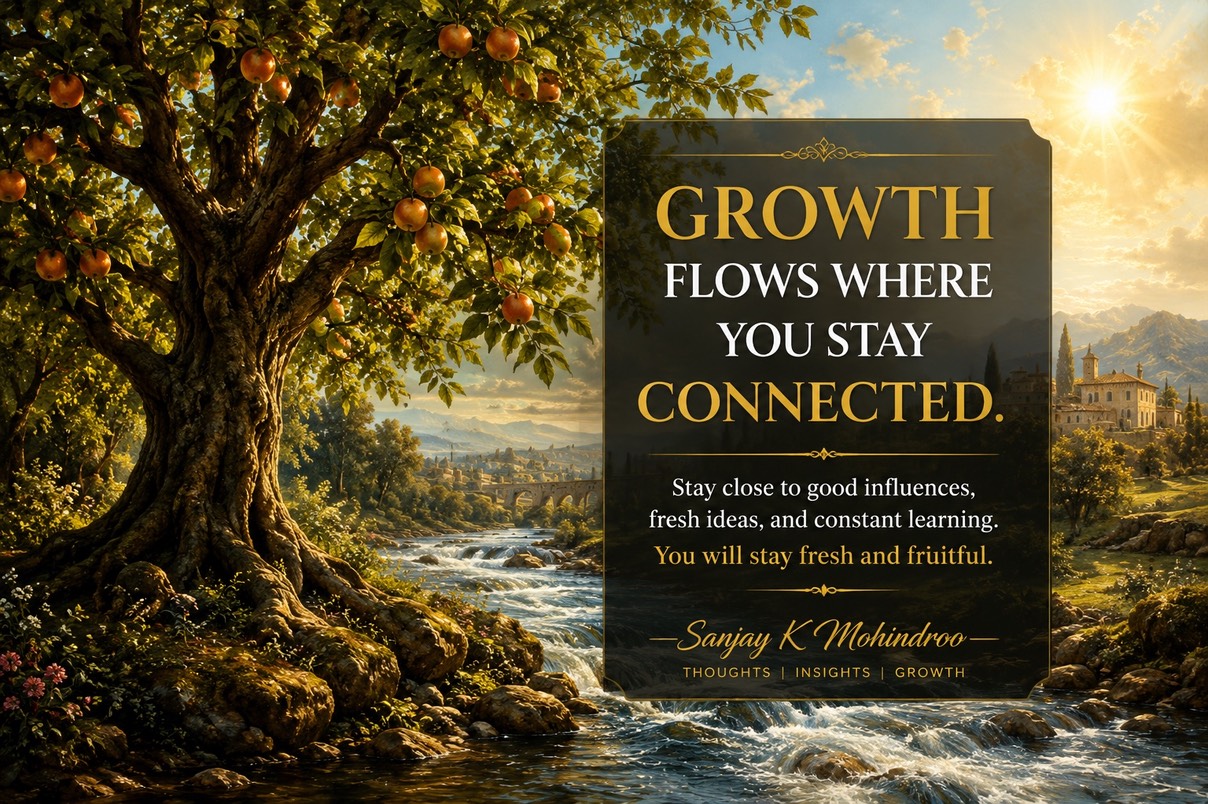
Roots Near the River.
Sanjay Kumar Mohindroo
Growth fades in stillness. The strongest minds stay close to movement, learning, and renewal.
A Living Source
Strength Drawn from Motion
“The tree that is beside the running water is
fresher and gives more fruit.”
— Saint Teresa of Avila
That line has stayed with me for days.
Not because it sounds poetic.
Because it feels brutally true.
You can see it in people.
You can see it in teams.
You can see it in companies, careers, and even nations.
The people who stay close to fresh ideas, honest feedback, hard work, deep thought, and new experiences keep growing. Their thinking stays alive. Their energy stays sharp. Their work carries weight.
The opposite also happens.
The moment people stop learning, stop listening, stop adapting, or stop exposing themselves to challenge, decline begins quietly. Not loudly. Not all at once. But slowly enough that most never notice it happening.
That is the danger of comfort.
A stagnant pond eventually smells stale. Running water stays fresh.
The same rule applies to the human mind.
The Cost of Mental Stillness
Comfort Creates Slow Decline
Many people think growth comes from talent alone.
It does not.
Growth comes from constant contact with movement.
New books.
New skills.
New people.
New failure.
New pressure.
New ideas.
This is the hidden fuel behind long-term excellence.
The best leaders rarely isolate themselves in old thinking. Great founders stay curious. Strong artists stay observant. Good managers keep listening. Elite athletes keep training in basics. Serious professionals never assume they have “arrived.”
That humility keeps them alive.
#GrowthMindset is not motivational fluff. It is survival.
The market changes. Technology changes. Human behavior changes. Business models change. Entire industries shift in five years.
People who stop moving mentally become outdated before they realize it.
And this is not only about work.
The same applies to emotional health.
People who stay connected to purpose, nature, good conversations, faith, creativity, family, and meaningful struggle often carry a different energy. They are not untouched by hardship. The sources around them simply renew them.
That matters more than most people admit.
The Trap of Closed Rooms
Success Without Renewal Fades Fast
One pattern appears again and again in high performers.
Many become successful. Few remain fresh.
There is a difference.
Some people build careers but lose curiosity.
Some gain authority but stop listening.
Some gain wealth but lose wonder.
Some gain followers but lose depth.
The result becomes visible over time.
Their ideas repeat themselves.
Their work loses force.
Their thinking becomes defensive.
Their confidence becomes fragile.
Stagnation rarely appears weak at first. Sometimes it even looks successful.
But stale thinking eventually exposes itself.
This is happening across industries today.
Many firms still run on old systems while speaking the language of innovation. Many leaders ask teams to adapt while resisting change themselves. Many people consume endless content but never pause to think deeply about anything.
Constant noise is not growth.
True growth requires nourishment.
That nourishment often comes from uncomfortable places.
Good books challenge us.
Good mentors correct us.
Good failure humbles us.
Good travel broadens us.
Good silence steadies us.
#Leadership grows stronger when it remains connected to renewal.
Energy Shapes Output
Fruit Reflects the Source
The quote also points toward another truth.
Output reflects input.
Healthy roots create strong fruit.
You cannot constantly feed your mind with distraction, outrage, shallow trends, and empty comparison while expecting clarity, wisdom, or strong work.
That equation never works.
Your environment shapes your thinking more than motivation does.
Spend time around bitterness, and bitterness spreads.
Spend time around disciplined people, and discipline rises.
Spend time around ambitious builders, and standards improve.
This is why the environment matters so much.
Not only the physical environment. Mental environment, too.
The people you follow.
The conversations you entertain.
The ideas you consume daily.
All of it becomes water to your roots.
#SelfDevelopment is less about hacks and more about choosing the right streams to stand beside.
That is also why burnout often feels deeper today.
Many people are overloaded but undernourished.
Busy, but disconnected.
Connected online, but mentally isolated.
Surrounded by content, but starved of meaning.
Human beings need renewal, not only productivity.
Renewal Builds Longevity
Fresh Minds Leave Deep Impact
There is another layer to this quote that deserves attention.
Fruit is not only about personal success.
Fruit means contribution.
A fresh mind gives more to others.
Better ideas.
Better leadership.
Better kindness.
Better systems.
Better art.
Better thinking.
People who stay connected to learning and renewal often become more generous over time because they are not operating from depletion alone.
That changes families.
That changes workplaces.
That changes institutions.
The strongest professionals I have met are usually not the loudest people in the room. They are the ones still asking questions after decades of success.
That mindset keeps them relevant.
#PersonalGrowth is not about chasing perfection. It is about refusing stagnation.
And maybe that is the deeper lesson here.
Growth is not an event.
It is a condition.
A tree does not become fruitful once and stay fruitful forever. It must remain connected to flowing water continuously.
Humans are no different.
Stay Near What Keeps You Alive
Pay attention to the sources feeding your life.
Some will drain you slowly.
Some will sharpen you quietly.
Choose wisely.
Stay close to ideas that challenge you.
Stay close to people who make you think better.
Stay close to work that keeps you awake inside.
Stay close to purpose.
Stay close to movement.
Freshness is not luck.
It is proximity.
And the people who remain connected to living water often become the ones who create the most lasting impact.
#GrowthMindset #Leadership #SelfDevelopment #PersonalGrowth #Mindset #Learning #CareerGrowth #ProfessionalGrowth #Purpose #Success
Saint Teresa of Avila was a 16th-century Spanish nun, writer, and spiritual thinker known for her sharp insight into human growth, discipline, faith, and inner strength. Her writings focused on clarity of thought, self-awareness, and purposeful living.
Nothing in Nature Is Random.
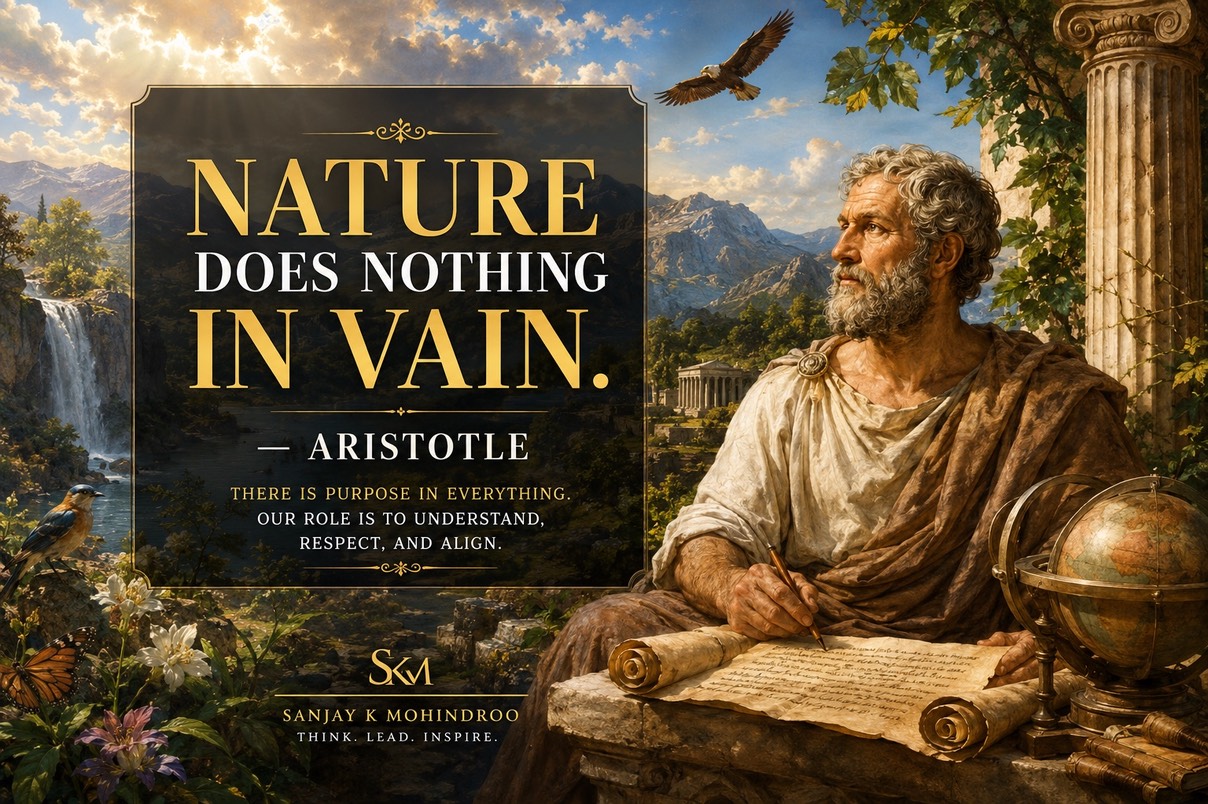
Sanjay Kumar Mohindroo
Nothing in Nature Is Random
Every pattern in nature carries a purpose. The same may be true for your work, failure, and growth.
A Quiet Line with Sharp Meaning
Purpose Hidden in Plain Sight
“Nature does nothing in vain.” — Aristotle
That line has survived for over two thousand years because it still unsettles us.
Look closely at nature. Nothing exists without a role. Forest fires clear dead growth. Storms reshape coastlines. Ant colonies work with ruthless order. Even decay feeds new life. Nature does not chase applause. It does not panic. It does not create excess without reason.
Yet people often live the opposite way.
We rush into work without meaning. We consume without pause. We chase titles we do not care about. We build habits that drain us. Then we wonder why we feel disconnected.
The quote is not just about trees, oceans, or biology. It is about structure. It is about intent. It is about the cost of living without direction.
That is the part many people avoid.
Patterns That Speak
Signals Most People Ignore
The strongest systems in life are built with balance. Nature proves this every day.
A tree does not grow all year. It rests.
A river does not fight every rock. It flows around them.
The human body does not heal through pressure alone. It heals through recovery.
There is a lesson here for modern work culture and leadership.
Many people confuse motion with progress. Endless meetings. Endless content. Endless noise. Yet very little impact. #Leadership and #Growth are not built through constant activity. They are built through focused action with clear intent.
Nature rewards systems that work together. It removes systems that waste energy.
That applies to companies too.
Businesses that ignore people burn out talent. Leaders who ignore ethics lose trust. Industries that ignore balance collapse under their own greed. History keeps repeating this pattern.
The warning signs are always there.
Nature is efficient. Human ego often is not.
The Weight of Every Experience
Pain With a Role
One of the hardest truths in life is this: painful experiences are rarely useless.
Failure teaches limits. Loss teaches value. Rejection forces clarity. Pressure reveals character.
That does not mean suffering is good. It means suffering can shape something stronger if we refuse to waste it.
This is where many people break.
They treat setbacks as proof they are finished. Nature treats disruption as part of growth. Forests regrow after destruction. Muscles rebuild after stress. Even stars collapse before creating new elements.
The process is uncomfortable, but it has meaning.
That perspective changes the way we face careers, relationships, health, and ambition.
Not every season is meant for winning publicly. Some seasons exist to build roots quietly.
That matters in a culture obsessed with instant success.
Modern Life and the Loss of Purpose
Noise Over Meaning
The modern system rewards attention more than depth.
People optimize for visibility instead of value.
Short-term praise replaces long-term craft.
Speed replaces patience.
The result is obvious. Many professionals look successful online but feel empty offline.
Nature offers a brutal contrast.
Nothing in nature tries to become viral. Yet everything works with discipline.
A bee pollinates without applause.
A mountain stands without marketing.
The sun rises without needing validation.
That does not mean ambition is wrong. Ambition is necessary. #Innovation, #Business, and #Technology move society forward. But ambition without purpose becomes hollow very quickly.
This is becoming a serious leadership issue.
Teams today do not only want salaries. They want meaning. Young professionals want work that connects to something larger than quarterly targets. Consumers are also changing. They reward brands that feel real, useful, and grounded.
Purpose is no longer a soft idea. It is becoming a competitive advantage.
Work Built with Intent
Craft Over Chaos
The people who create lasting impact usually follow one pattern.
They work with intention.
Great architects think about human movement before drawing buildings. Great engineers think about function before scale. Great writers think about truth before popularity.
Purpose shapes quality.
This applies to daily life too.
A strong routine has purpose.
A healthy friendship has purpose.
A meaningful career has purpose.
Without purpose, effort becomes scattered.
That is where burnout begins.
Many people are exhausted not because they work hard, but because they work without connection to anything meaningful.
Nature does not waste effort. Every movement supports survival, growth, or balance.
That idea should challenge every leader, creator, policymaker, and
professional reading this.
Are we building systems that actually matter?
Or are we creating noise because noise feels productive?
A Stronger Way Forward
Living With Design Instead of Drift
The quote from Aristotle is not asking people to become passive. It asks people to become aware.
Look at your habits.
Look at your work.
Look at your relationships.
Ask a direct question: Does this serve a real purpose?
If the answer is no, change it.
Nature removes what no longer serves balance. People often hold onto it for years.
That includes careers built on fear.
Partnerships built on convenience.
Goals borrowed from other people.
A meaningful life requires intention. Not perfection. Not endless hustle. Intention.
That is the real force behind long-term success and inner stability.
The people who understand this become harder to distract. Harder to manipulate. Harder to break.
Because they stop living randomly.
Meaning Leaves a Mark
Nature does not create without reason. Every cycle, every shift, every system carries intent.
Maybe the same should be true for us.
The strongest careers are built with purpose.
The strongest leaders act with clarity.
The strongest people turn pain into direction.
Nothing meaningful is built by accident.
And perhaps the biggest waste in modern life is not failure. It is living without intention while pretending to be busy.
That is the challenge hidden inside Aristotle’s words.
A Mind That Still Shapes Modern Thought
Aristotle was an Ancient Greek philosopher and student of Plato. His work shaped philosophy, science, ethics, politics, and logic for centuries. Many modern ideas around purpose, systems, and human behavior still trace back to his thinking.
Beyond the Cradle.

Sanjay Kumar Mohindroo
Humanity’s Next Great Step
Humanity was never meant to stand still. Growth begins the moment we outgrow comfort.
“‘The Earth is the cradle of humanity, but mankind cannot stay in the cradle forever.’ — Konstantin Tsiolkovsky
Few lines capture human ambition with this much force.
A cradle is safe. Warm. Familiar. It protects us while we grow. But staying there too long becomes a trap.
That is the deeper truth behind this quote.
Human progress has never come from comfort. It came from people willing to leave the known behind. Every major leap in history began with risk, doubt, and curiosity. The first ships crossing unknown seas. The first aircraft breaking gravity. The first computers changing human thought. The first rockets leaving Earth.
Each step looked impossible before it became normal.
Today, we stand at another turning point.
Humanity is building systems that can think, create, calculate, and connect faster than ever before. #ArtificialIntelligence is changing work. #SpaceTechnology is becoming commercial. Private companies are launching rockets that were once controlled only by governments. Nations are racing to secure leadership in #QuantumComputing, robotics, biotech, and advanced energy systems.
This is not science fiction anymore. It is a strategy. It is economics. It is power.
And yet many people still think small.
Many institutions still reward safety over vision. Many leaders still focus only on short-term survival. Many companies still fear change until disruption forces them to react.
History is ruthless with those who refuse to move.
The nations and organizations shaping the future today are not waiting for certainty. They are investing before the outcome is guaranteed. They understand a hard truth: comfort creates stagnation.
That applies to people, too.
Most careers fail quietly, not dramatically. People stop exploring. Stop learning. Stop adapting. They settle into routines that feel safe but slowly limit growth. The danger is not failure. The danger is becoming too comfortable with the average.
Curiosity matters more now than ever.
The next decade will reward people who can think across fields. Technology alone will not define success. Human judgment, ethics, creativity, communication, and courage will matter just as much. The strongest leaders will combine technical understanding with imagination.
That is where real progress happens.
This quote also carries another message. Expansion is part of human nature. Civilizations grew because humans kept moving outward. From caves to cities. From maps to satellites. From local trade to global networks. Exploration is not separate from humanity. Exploration is humanity.
#Innovation has always begun with dissatisfaction toward limits.
The most exciting part is this: we are still early.
Space exploration is entering a new era. Reusable rockets lowered launch costs. Lunar missions are returning. Mars is no longer just an idea discussed in books. Nations are preparing long-term space strategies because they know the next economic and scientific race may not happen on Earth alone.
That changes everything.
Resources, communication, defense, climate monitoring, and scientific research are all tied to space capability now. Countries investing early will shape the next century of influence. Countries that hesitate may spend decades trying to catch up.
India understands this shift well.
The rise of the Indian Space Research Organization and the rapid growth of private Indian space startups show that ambition is growing beyond traditional limits. Missions once seen as impossible are now part of national planning. Young engineers and scientists are entering fields that barely existed a generation ago.
That mindset matters more than technology itself.
Because every breakthrough begins first as a belief.
The quote is not only about rockets or planets. It is about refusing to remain mentally small. It is about rejecting the idea that current limits define permanent limits. It is about understanding that progress demands movement.
A society that stops exploring starts declining.
The same applies inside organizations. Businesses that avoid experimentation lose relevance. Leaders who avoid hard change lose trust. Teams that stop learning lose competitiveness.
Growth always asks for discomfort first.
That is the price of moving forward.
The people shaping the future are rarely the people protecting old systems. They are usually the ones questioning accepted limits. They are willing to sound unrealistic before success proves them right.
That pattern repeats across history.
Every generation inherits a boundary it believes cannot be crossed. Then someone crosses it.
That is the spirit behind this quote. Not escape from Earth, but expansion of human possibility.
Humanity was never designed to stand still.
And maybe the greatest risk today is not moving too fast. It is thinking too small while the future accelerates around us.
#Leadership #FutureOfWork #SpaceExploration #Technology #HumanPotential #Innovation #AI #Science #GrowthMindset #IndiaTech
Konstantin Tsiolkovsky was one of the founding thinkers of modern astronautics. His ideas on rocketry and human space travel shaped early space science decades before space missions became reality. Many consider him one of the intellectual pioneers behind modern space exploration.
Freedom That Demands More from Us.

Sanjay Kumar Mohindroo
Freedom means little if it does not push us to grow beyond comfort, fear, and excuses.
A Line That Still Hits Hard
The Weight Behind Simple Words
“Freedom is nothing but a chance to be better.”
By Albert Camus.
Few lines explain modern life this clearly.
People speak about freedom every day. Freedom of choice. Freedom of speech. Freedom to live life on your terms. Yet most people never ask the harder question:
Better for what?
Better as a worker?
Better as a leader?
Better as a citizen?
Better as a human being?
That is where this quote cuts deeper than most.
It does not treat freedom as comfort. It treats freedom as responsibility.
And that changes everything.
#Leadership #GrowthMindset #SelfAwareness are often framed as personal wins. Yet real growth starts when freedom stops being about escape and starts becoming about effort.
A free society gives opportunity. It does not guarantee character.
That part is still our job.
Comfort Has Become the New Trap
Easy Access, Weak Direction
Modern life gives us endless options.
We can switch careers.
Build companies.
Create content.
Speak publicly.
Travel anywhere.
Consume endless knowledge.
Yet many people still feel stuck.
That is not because freedom failed.
It is because freedom without direction creates drift.
A person can have total freedom and still waste years avoiding hard truths. We see this in careers, business, politics, and even relationships. People seek comfort while calling it peace. They avoid risk while calling it balance. They stay average while convincing themselves they are “waiting for the right time.”
That waiting becomes a habit.
And habits shape identity.
#CareerGrowth and #PersonalDevelopment are not built through motivation alone. They are built through repeated choices that most people delay.
Freedom gives space.
Discipline gives shape.
Without discipline, freedom slowly becomes noise.
Better Is a Daily Decision
Small Choices Build Real Character
Most people imagine growth as a huge turning point.
It rarely works that way.
Growth looks ordinary in real life.
Waking up early to prepare properly.
Having difficult conversations, honestly.
Reading instead of scrolling.
Taking ownership after failure.
Learning new skills after work hours.
Speaking less and listening more.
These are small acts.
But repeated over the years, they separate people completely.
The uncomfortable truth is simple:
Freedom exposes character faster than pressure does.
Under pressure, people react.
With freedom, people reveal priorities.
Some people build.
Some distract themselves.
Some complain endlessly.
Some improve quietly.
That gap becomes visible over time.
#Mindset and #Success is rarely about talent alone. They are usually about whether someone used their freedom to grow or to hide.
Strong Societies Depend on Better Individuals
Rights Mean Little Without Standards
This quote also matters beyond personal life.
Every society wants freedom. That is natural.
But freedom without standards creates decline.
A healthy workplace needs accountability.
A healthy democracy needs informed citizens.
A healthy economy needs ethical ambition.
A healthy family needs responsibility.
When people demand rights without improving conduct, systems weaken from within.
That is the part many avoid discussing.
Real progress is not built only through policy or technology. It is built through personal standards repeated at scale.
#Responsibility and #Discipline are not old-fashioned ideas. They are the foundation of trust.
And trust holds every institution together.
This matters deeply in leadership today.
Many leaders want authority. Few want self-control.
Many want visibility. Few want substance.
Yet the strongest leaders are usually the ones who keep improving long after they no longer need external approval.
That quiet discipline creates long-term respect.
Freedom and Fear Cannot Coexist Forever
The Cost of Staying Comfortable
Most people are not trapped by a lack of freedom.
They are trapped by fear.
Fear of failure.
Fear of judgment.
Fear of looking inexperienced.
Fear of starting late.
Fear of losing status.
So, they stay in safe routines.
Years pass.
Potential fades slowly, not suddenly.
This is where the quote becomes deeply personal.
Freedom gives us the chance to act despite fear.
Not after fear disappears.
Despite it.
That distinction matters.
Because courage is not confidence.
Courage is movement before certainty.
#Motivation becomes meaningful only when action follows.
Otherwise, it is entertainment.
And social media is full of entertained people who never move.
A Better Life Needs Honest Reflection
The Mirror Most People Avoid
The hardest part of freedom is accountability.
When nobody controls your choices, excuses lose power.
You cannot blame the system forever.
You cannot blame timing forever.
You cannot blame luck forever.
At some point, growth becomes personal.
That does not mean every system is fair. Many are not.
But even inside unfair systems, people still choose who they become.
That is where dignity lives.
In the choice to improve despite difficulty.
#HumanPotential is not unlocked through comfort alone. It is unlocked through responsibility, reflection, and consistent effort.
That process is rarely glamorous.
But it is powerful.
The Standard Worth Chasing
Freedom Earns Meaning Through Action
The real beauty of this quote is its honesty.
Freedom is not presented as a reward.
It is presented as an opening.
An opportunity.
A test.
A chance to become sharper, wiser, kinder, stronger, and more useful to the people around us.
That is a far higher standard than modern culture usually offers.
And maybe that is exactly why the quote still matters today.
Because the strongest people are rarely the loudest or the most comfortable.
They are the ones who used their freedom well.
Not perfectly.
Not flawlessly.
But intentionally.
That is enough to change a life.
#Leadership #GrowthMindset #SelfAwareness #CareerGrowth #PersonalDevelopment #Mindset #Success #Responsibility #Discipline #Motivation #HumanPotential
Albert Camus was a French philosopher, author, and journalist known for his work on human freedom, responsibility, and meaning. His writing challenged people to face life honestly, without excuses or false comfort.
The Real Decision Behind Every Election

Sanjay Kumar Mohindroo
Power Before Policy
“Voters don't decide issues, they decide who
will decide issues.”
— George Will
That line cuts through most modern political noise in seconds.
Every election cycle brings endless debates. Taxes. Jobs. AI. Privacy. Climate. National security. Education. Welfare. Trade. People argue over policies as if elections are giant public referendums on every single issue.
They are not.
Most citizens never read full policy drafts. Most people never study legislative detail. Most do not compare budget frameworks or legal texts. They choose people. They choose judgment. They choose temperament. They choose trust. They choose competence. They choose who they believe should hold authority when hard choices arrive.
That changes the entire meaning of democracy.
The deeper question is not, “Do you agree with
every policy?”
The deeper question is, “Who do you trust when reality becomes messy?”
That is where leadership begins.
Public Trust and Political Power
The Weight of Representation
Strong democracies are built on delegated judgment.
That idea makes many people uncomfortable today. Social media rewards instant opinions. News cycles reward outrage. Political branding rewards emotional reaction. Yet governing a nation demands patience, trade-offs, and long-term thinking.
No citizen can monitor every file, negotiation, intelligence brief, economic signal, or global shift. That is impossible. A government handles thousands of moving parts every day. From cyber security to trade talks to health systems to energy planning, leadership often means making decisions the public may never fully see in real time.
This is where #Leadership becomes more important than slogans.
A capable leader absorbs pressure without collapsing into chaos. A capable institution filters emotion from action. A capable government balances short-term anger with long-term national interest.
Many voters sense this instinctively.
That is why elections often turn on character more than technical detail.
People ask themselves simple questions:
Can this person handle a crisis?
Can this team stay calm under pressure?
Can they make difficult calls without losing direction?
Can they carry responsibility when outcomes are uncertain?
That is not blind loyalty. That is a political judgment.
The Crisis of Shallow Debate
Noise Without Depth
Modern political discussion has become trapped in performance.
Many public debates now revolve around clips, trends, and outrage bursts. Complex national questions are reduced to short emotional battles. Serious governance gets treated like entertainment.
The result is dangerous.
Citizens begin to believe leadership is only about speaking loudly. It is not. Leadership is about deciding under uncertainty. Real governance involves incomplete data, economic limits, legal boundaries, diplomatic pressure, and social consequences.
Every major national decision creates winners and losers.
There is no perfect policy. There are only choices with trade-offs.
That is why mature democracies require mature voters.
Not voters who agree on everything. That will never happen. Democracies are supposed to contain disagreement. The real test is whether citizens can identify people capable of carrying institutional responsibility.
This is where #Governance and #PublicPolicy become deeply human subjects, not just technical ones.
Competence matters. Integrity matters. Stability matters. Judgment matters.
And calm leadership matters far more during difficult periods than during easy ones.
Institutions Shape Nations
Beyond Individual Charisma
One strong leader alone cannot sustain a nation.
Institutions matter more than personalities over time.
Courts. Civil services. Regulatory systems. Electoral systems. Media standards. Education systems. Economic frameworks. These structures shape whether a country stays stable during periods of stress.
Good voters understand this.
They do not only ask, “Do I like this politician?”
They ask, “Will this leadership strengthen institutions or weaken them?”
That distinction defines the future of countries.
Nations decline slowly before they collapse visibly. Trust erodes first. Institutional respect weakens next. Public cynicism rises after that. Finally, every decision becomes tribal warfare instead of national problem-solving.
Strong democracies avoid this spiral by protecting institutional credibility.
That is why #Democracy is not merely voting day. Democracy is a long-term culture of responsibility between citizens and institutions.
The healthiest democracies are not the loudest ones. They are the ones where citizens still believe systems can function fairly, even when outcomes disappoint them.
The Human Side of Political Choice
Emotion, Fear, and Hope
Most voting decisions are emotional before they become rational.
People vote from memory. Fear. Aspiration. Identity. Economic stress. Cultural trust. Personal experience. Hope for stability. Desire for dignity.
This is normal.
Politics has always been emotional because leadership affects everyday life. Jobs, prices, safety, healthcare, opportunity, and national confidence all connect directly to governance.
The mistake is pretending emotions alone are enough.
Emotion without judgment creates instability. Judgment without empathy creates detachment.
The strongest public leaders combine both.
They understand systems, but they also understand people.
That balance separates statesmanship from performance.
And voters often recognize that difference more clearly than elites assume.
The Quiet Responsibility of Citizenship
Choosing the Decision-Maker
Every citizen carries more influence than they think.
A vote is not only support for a manifesto. It is an endorsement of decision-making authority. It is permission. It is a trust handed over temporarily.
That should make every election feel serious.
Not dramatic. Serious.
The future of economies, institutions, innovation, security, and public trust often depends less on perfect policy design and more on the quality of the people empowered to act when unexpected moments arrive.
That may be the most important civic lesson of all.
Because history rarely asks nations whether they memorized policy details.
History asks whether societies placed responsibility in capable hands when it mattered most.
And that choice shapes generations.
George Will is an American political commentator, columnist, and author known for his writing on democracy, governance, political institutions, and civic responsibility.
Nature Never Lies.

Sanjay Kumar Mohindroo
The Quiet Teacher We Keep Ignoring
Truth becomes clearer when we stop fighting nature and start paying attention.
“Read nature; nature is a friend to truth.” — Edward Young
We live in a time full of noise. Endless opinions. Endless advice. Endless attempts to shape reality into something easier to sell, easier to defend, or easier to consume.
Yet the most honest lessons still come from the oldest source around us.
Nature does not perform. Nature does not pretend. Nature does not bend facts to protect feelings or feed ego. A storm arrives when pressure builds. A tree grows slowly because strong roots take time. Rivers cut through stone through steady force, not loud force.
That honesty matters today more than ever.
In business, leadership, health, policy, and life, people often chase shortcuts. We reward speed over depth. Visibility over value. Noise over wisdom. Then we wonder why burnout rises, trust falls, and clarity disappears.
The answer sits in plain sight.
Look closely at any natural system. Balance matters. Timing matters. Patience matters. Excess always creates damage. Ignoring warning signs always carries a cost.
That applies to companies, too.
A company can force growth for a while. It can overwork teams, inflate numbers, chase hype, and ignore cracks beneath the surface. But reality catches up. Nature always exposes weak foundations. Markets do the same. So do people.
The strongest organizations often mirror natural systems. They adapt. They conserve energy. They build strong roots before rapid expansion. They understand cycles. They know rest is not weakness. They know long-term trust matters more than short-term applause.
That is not poetry. That is a strategy.
#Leadership and #DecisionMaking become sharper when people observe patterns instead of reacting to trends.
Nature teaches restraint. Modern culture rewards excess.
Nature teaches patience. Modern culture rewards urgency.
Nature teaches renewal. Modern culture rewards endless output.
One path creates stability. The other creates exhaustion.
This disconnect shows up everywhere.
Cities expand without breathing room. People work without pause. Leaders speak without listening. Platforms reward outrage because outrage keeps attention alive. We consume more information than any generation before us, yet many people feel less certain about truth.
That should concern us.
Because truth does not become clearer through volume alone. It becomes clearer through observation.
Farmers understand this deeply. Builders understand it. Craftsmen understand it. Athletes understand it. Good leaders understand it too. They pay attention to signals before problems become disasters.
Nature operates through feedback. Ignore feedback long enough, and systems fail.
That applies to climate. It applies to economies. It applies to mental health. It applies to relationships. It applies to leadership.
The warning signs are usually visible early. People just choose convenience over honesty.
#Growth built against reality rarely survives.
One of the biggest mistakes modern professionals make is treating themselves like machines instead of living systems. Sleep gets cut. Attention gets fractured. Reflection disappears. Then productivity drops, and people search for another hack.
There is no hack for ignoring human limits.
Even forests recover after fire through time and balance. Human beings are no different. Recovery is not laziness. Reflection is not a weakness. Silence is not emptiness.
Some of the best decisions come from stepping away long enough to see clearly again.
That is where nature becomes powerful. It strips away illusion.
A mountain does not care about status. The ocean does not care about titles. A sunrise does not change because someone has more followers online. Nature reminds people how small they are, but also how connected they are.
That balance creates perspective.
And perspective creates better judgment.
#Mindset and #Leadership are shaped less by constant stimulation and more by deep observation.
There is another hard truth here.
Nature rewards consistency more than intensity.
A river reaches the sea through persistence. Seasons change without needing applause. Trees grow every day, even when nobody notices. Yet people today often quit too early because progress is not visible fast enough.
Real progress is often quiet at first.
The strongest careers, businesses, relationships, and ideas usually grow slowly before they become obvious. That is difficult for people raised in an age of instant feedback.
But truth rarely moves at the speed of social media.
It moves at the speed of reality.
And reality always wins in the end.
That is the deeper force behind this quote. It is not asking people to admire scenery. It is asking them to observe reality honestly. Nature reflects consequences without bias. It shows cause and effect clearly. It rewards balance and exposes excess.
That lesson matters in every field today.
In #Business, it means building durable systems instead of chasing hype.
In #Innovation, it means solving real problems instead of creating empty noise.
In #Wellbeing, it means respecting physical and mental limits before collapse forces change.
In #Leadership, it means listening before speaking and observing before reacting.
People often search for truth in complex places while ignoring the simple signals around them every day.
The patterns are already there.
The question is whether we are paying attention.
The strongest minds are not always the loudest minds. They are often the people who observe deeply, think clearly, and stay grounded in reality even when the crowd moves elsewhere.
That kind of thinking builds trust. It builds wisdom. It builds endurance.
And in a distracted age, endurance matters.
Because trends fade. Noise fades. Hype fades.
Reality does not.
#Leadership #Truth #Mindset #Growth #DecisionMaking #Business #Innovation #Wellbeing #SelfAwareness #HumanNature #Wisdom #ProfessionalGrowth #CriticalThinking #PersonalGrowth #Reflection
Edward Young was an 18th-century English poet, writer, and thinker known for his reflective works on life, truth, time, and human nature. His writing often explored moral clarity, self-awareness, and the deeper patterns shaping human behavior.
The Weight of a Hand Extended.

Sanjay Kumar Mohindroo
Real support begins when effort costs you something, not when it only looks good publicly.
“Never reach out your hand unless you're
willing to extend an arm.”
— Pope Paul VI
Most people love the idea of helping.
Very few love the cost of it.
That quote hits hard because it exposes a quiet truth about modern life. Support has become easy to announce and hard to sustain. We praise kindness in public, yet avoid discomfort in private. We offer words faster than time. We promise to help faster than effort.
And people notice.
Every workplace notices it. Every friendship feels it. Every team remembers it.
The gap between saying “I’m here for you” and actually showing up has become one of the biggest trust issues in modern leadership, business, and human connection. #Leadership #Trust
The Surface of Support
Empty gestures leave deep marks
A quick message is easy.
A repost is easy.
A “let me know if you need anything” text is easy.
Real help is not.
Real help interrupts schedules. It takes energy. It costs time. Sometimes it risks comfort, money, reputation, or convenience. That is the point behind the quote. The message is not about charity alone. It is about commitment.
If your support ends where inconvenience begins, people will remember that.
This matters in management. It matters in politics. It matters in families. It matters in business partnerships. People stop believing leaders who speak about values but disappear under pressure. #Management #WorkCulture
The strongest leaders are rarely the loudest people in the room. They are the ones who stay present when things get hard.
That creates loyalty no speech can buy.
The Quiet Crisis Around Us
Performance has replaced presence
We live in a time of visible concern and invisible effort.
People post support online yet ignore calls from struggling friends. Companies speak about employee care while burning teams out behind closed doors. Brands speak about community while squeezing vendors on payments. Professionals speak about mentorship while refusing to spend real time with juniors. #Mentorship #ProfessionalGrowth
This is not cynicism. It is reality.
And people are exhausted by it.
The reason trust feels fragile today is not that humans have become colder. It is because actions have become shallow. Public image grew faster than personal integrity.
The quote challenges that directly.
It asks a brutal question:
Are you willing to go beyond symbolic support?
Because real character begins where convenience ends.
Leadership Under Pressure
Respect grows through sacrifice
Every respected leader carries stories nobody saw.
Late-night calls answered.
Risk taken for teams.
Difficult conversations handled privately.
Credit is shared openly.
Blame absorbed quietly.
That is extending an arm instead of merely offering a hand.
In strong organizations, people do not follow titles for long. They follow proof. #TeamBuilding #CareerGrowth
A manager who protects their team during failure earns more trust than one who celebrates success loudly.
A founder who stands beside employees during crisis builds stronger culture than one who posts motivational quotes daily.
A friend who quietly stays during hard times becomes unforgettable.
This is where leadership stops being strategy and starts becoming character.
Human Connection Still Wins
Effort remains the strongest signal
People rarely remember polished speeches.
They remember who stayed.
That truth cuts across every part of life.
In business, clients remember responsiveness during problems more than polished pitches.
In relationships, consistency matters more than dramatic promises.
In mentorship, honesty matters more than inspiration.
In society, people trust institutions that act during crisis, not only during campaigns. #HumanConnection #Authenticity
The strongest relationships are built through repeated acts of effort.
Not an image.
Not branding.
Not performance.
Effort.
That is why the quote still feels timeless decades later. Human beings can detect sincerity faster than we admit.
A Hard Truth About Modern Success
Ambition without humanity creates hollow wins
Modern work culture rewards speed, visibility, and self-promotion. None of those are bad alone. The problem starts when success becomes detached from responsibility.
People want loyalty from teams without giving support back.
People want trust without consistency.
People want strong networks while avoiding emotional investment.
That approach eventually collapses.
Because influence built only on usefulness disappears once usefulness fades.
The people remembered for decades are rarely those who simply achieved power. They are the people who carried others while climbing. #Influence #PersonalGrowth
That is the deeper emotional force inside the quote.
Real impact demands emotional weight.
The Standard Worth Keeping
Strong people stay available
One of the most admirable traits in any person is reliability.
Not perfection.
Reliability.
Knowing someone will stand beside you changes everything. It creates confidence, courage, and stability.
The same applies to institutions, leaders, and nations.
A culture becomes stronger when people stop treating support like a public performance and start treating it like a duty.
That shift changes workplaces.
It changes families.
It changes communities.
And it changes people internally, too.
Because the act of showing up consistently shapes character. #Integrity #GrowthMindset
A Closing Thought That Stays
Anyone can offer sympathy.
Commitment is rarer.
The people who leave the deepest mark are not those who speak the most about care. They are the ones willing to carry the weight when it matters.
That standard feels demanding because it is.
But it is also the foundation of trust, respect, leadership, and meaningful human connection.
A hand may signal intent.
An arm signals responsibility.
And people always know the difference.
Pope Paul VI was known for his focus on social justice, peace, human dignity, and moral responsibility during a period of major global change. His words often reflected duty, compassion, and the need for action over symbolism.
The Quiet Confidence of Nature.

Sanjay Kumar Mohndroo
A smile in nature says more about life than most success quotes ever will.
A Smile Older Than Us All
“All nature wears one universal grin.” — Henry Fielding
That line feels simple at first. Almost too simple.
Then you sit with it.
You watch sunlight break through clouds after a hard week. You hear birds before a busy morning begins. You stand near the sea, the hills, or a tree older than your worries. Something shifts inside you.
Nature does not rush to impress anyone. It does not compete for applause. It does not chase trends, status, or noise. Yet it keeps moving with quiet strength.
That is the grin.
Not laughter. Not performance. Not forced joy.
A calm confidence.
And maybe that is the lesson many of us miss while chasing speed, titles, and endless goals in modern #Leadership and #Success culture.
The Noise We Built Around Ourselves
Progress Without Peace
Modern life rewards urgency.
Reply faster. Work longer. Stay visible. Keep proving yourself.
Most people now live in a loop of screens, meetings, traffic, deadlines, and alerts. We celebrate exhaustion as ambition. We treat stillness like weakness.
Yet the human mind was never built for constant noise.
You can see it everywhere.
People have more tools but less peace. More access but less focus. More followers but fewer connections.
Burnout has become normal in many careers. Anxiety hides behind polished LinkedIn updates. Even rest now feels planned and measured.
That is not balanced.
Nature exposes this truth very clearly.
A forest does not panic because another forest grows faster.
The sky does not compete with the ocean.
The sun rises daily without needing validation.
There is deep power in that rhythm. #Mindset and #MentalWellbeing are not built only through productivity systems. They are shaped through perspective.
The Silent Strength Around Us
Lessons Hidden in Plain Sight
Nature teaches through repetition.
Every season carries a message.
Summer shows endurance.
Rain shows renewal.
Winter shows patience.
Spring shows return.
Nothing in nature stays frozen forever. Growth comes in cycles. Rest is part of progress, not the enemy of it.
That matters in careers, business, leadership, and personal growth.
Many professionals fear pauses. They fear setbacks. They fear slow phases.
But real growth is rarely loud.
A tree spends years building roots before others admire its height.
That is true for people, too.
Strong careers are often built quietly. Strong minds are shaped during difficult seasons. Strong leaders are formed through reflection, not only pressure.
In #Business and #CareerGrowth, people often chase visible wins while ignoring inner stability.
Nature reminds us that stability creates lasting strength.
A Better Definition of Success
Presence Over Performance
Many people spend years trying to look successful instead of feeling alive.
There is a difference.
One creates pressure.
The other creates meaning.
Nature does not fake its beauty. A mountain does not ask for approval before standing tall. A river does not stop flowing because someone doubts its direction.
That honesty feels rare today.
People edit emotions, polish failures, and turn life into performance. Yet authenticity still attracts more respect than perfection ever will.
The professionals who inspire others most are often grounded people. Calm people. Clear people.
Not the loudest.
The strongest leaders bring steadiness into chaos. They make others feel safe. They stay balanced under pressure.
Nature operates the same way.
That universal grin is not naïve happiness. It is calm acceptance of life’s flow.
There will be storms.
There will also be sunlight again.
The Human Need for Wonder
Losing Touch with the Real
Many adults stop noticing beauty.
That is a dangerous habit.
Children notice everything. Rain on the windows. Shapes in clouds. The smell after rain. Wind through trees.
Adults stop looking because they are busy managing life.
But wonder is not childish. It is fuel for creativity, clarity, and emotional strength.
Some of the best thinkers, artists, scientists, and builders stayed connected to nature throughout their lives. They understood that deep thought needs space.
Constant stimulation weakens reflection.
Even five quiet minutes outside can reset the mind more than endless scrolling.
This is not philosophy alone. Studies in #Psychology and #Wellness continue to show that time in natural spaces improves focus, mood, and emotional balance.
The body relaxes.
The mind slows down.
Perspective returns.
That matters more than most people admit.
A Hard Truth Worth Accepting
Control Is Often an Illusion
Nature also teaches humility.
Humans like control. Plans make us feel secure.
But storms still come. Markets crash. Careers change. Health shifts. People leave. Plans fail.
Nature has always known this.
Yet it continues without bitterness.
There is strength in adapting instead of resisting every change.
The strongest people are rarely those who control everything. They are the ones who recover, adjust, and continue moving.
Like rivers finding new paths.
Like forests growing back after fire.
Like seasons returning after loss.
That is real resilience.
Not motivational slogans.
Not fake positivity.
Steady movement despite uncertainty.
The Smile We Keep Forgetting
A Reminder Worth Carrying
Maybe the greatest message hidden inside that quote is this:
Life was never meant to feel disconnected from the living world around us.
Nature keeps offering perspective every single day. Most people are simply too distracted to notice it.
The sky still changes colour every evening.
Trees still grow without applause.
Birds still sing without an audience.
And somewhere inside all of that is a quiet reminder that peace does not come from owning more, proving more, or shouting louder.
It comes from alignment.
From presence.
From remembering that life moves in rhythms, not races.
That universal grin still exists.
The question is whether we still have the attention span to see it.
Henry Fielding was an 18th-century English writer known for sharp social insight, humour, and deep observations about human nature. His work often explored morality, society, and the emotional patterns that shape people and life.
History’s Second Draft.
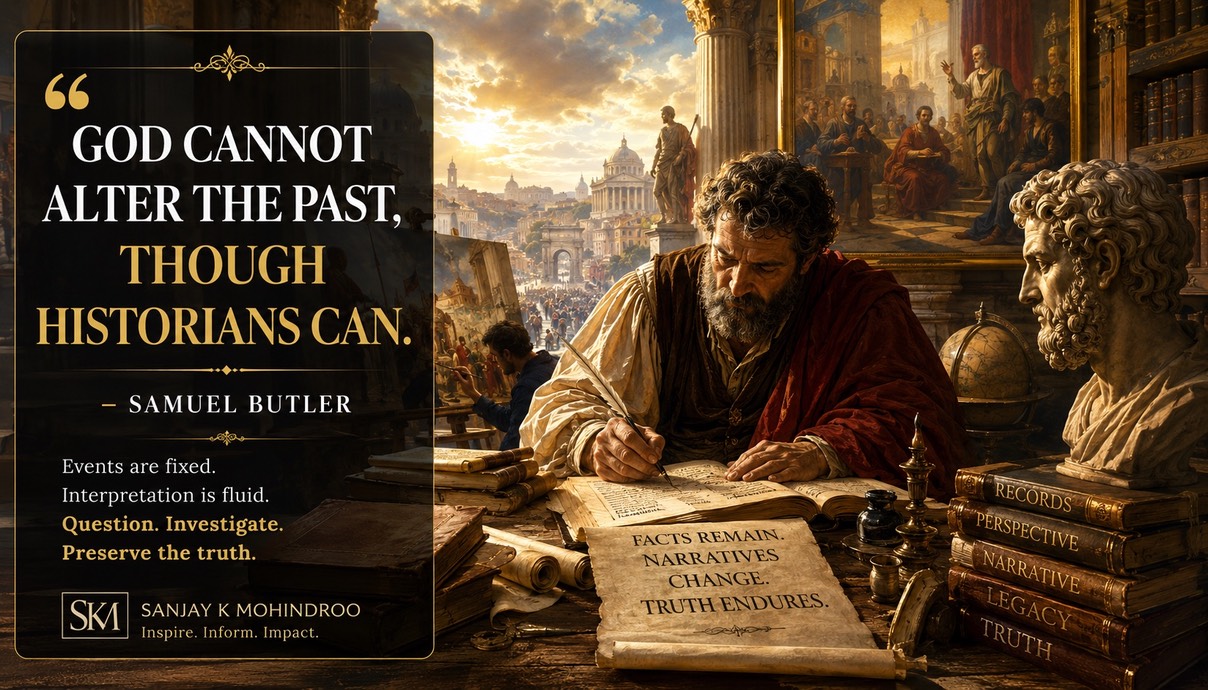
Sanjay Kumar Mohindroo
The past never changes. The story around it does. That difference shapes power, memory, and truth.
“God cannot alter the past, though historians can.” — Samuel Butler
That line hits hard because it exposes a truth most people avoid.
Facts happen once. Narratives happen forever.
The event is fixed. The retelling is not.
Every generation edits memory in its own way. Nations do it. Corporations do it. Leaders do it. Even families do it. The past becomes a mirror people shape to protect pride, justify choices, or build identity. #Leadership #History #Truth
History is not only about records. It is about influence.
The people who control the story often shape public belief more than the people who lived through the event. That should make every professional pause. In business, politics, media, and public life, perception can outlive reality by decades.
Look at any major turning point. Wars. Economic reforms. Political movements. Corporate collapses. The first version is raw. The later version becomes polished. Over time, uncomfortable details fade. Heroic details grow louder. Blame moves around. Credit changes hands. #PublicPolicy #Media #Strategy
This is not always evil. Sometimes it is survival.
Societies need stories to stay stable. Teams need stories to stay united. Countries need stories to build shared purpose. But there is a fine line between creating meaning and rewriting truth.
That line matters more today than ever.
We now live in an age where information moves faster than reflection. A clip goes viral before context arrives. Headlines spread before facts settle. A false narrative can reach millions before the correction reaches thousands. #AI #Communication #DigitalTrust
That changes the role of historians completely.
The modern historian is no longer just a scholar in archives. Today, journalists, creators, analysts, influencers, governments, and even algorithms shape historical memory in real time. Every post becomes part of a public record. Every edited clip becomes a version of history.
This is where the quote becomes deeply relevant.
The line is not mocking historians alone. It is warning society about the power of interpretation.
A person may win a battle and still lose the story around it. Another may fail badly yet become celebrated later because the narrative changed. History often rewards those with influence over memory, not only those with truth on their side. #Narrative #Power #Society
That should concern every thinking professional.
In organizations, this happens quietly every day.
A failed project gets reframed as a “learning phase.” A poor decision becomes “market timing.” A toxic culture becomes “high-performance pressure.” Over time, the official version replaces lived experience.
People rarely remember the raw moment. They remember the final story told about it.
That is why documentation matters. Honest leadership matters. Open debate matters. Institutions matter. Without them, memory becomes a tool of convenience.
There is another side to this quote that deserves attention.
Human beings naturally rewrite their own pasts.
We soften old mistakes. We magnify old wins. We reshape memories to protect identity. Many people are not lying intentionally. They are trying to make peace with themselves.
That makes this quote deeply human.
Memory is emotional before it is factual.
Two people can live through the same event and carry entirely different truths from it. One remembers pain. Another remembers growth. One remembers betrayal. Another remembers sacrifice. #HumanNature #Mindset #Growth
This is where wisdom enters the conversation.
Strong people do not fear the truth of their past. They face it directly. They do not need to rewrite every mistake into a victory story. They accept flaws, own failures, and move forward with clarity.
That creates credibility.
People trust leaders who speak honestly about setbacks. They trust organizations that admit errors. They trust nations that confront difficult chapters instead of hiding them.
Truth builds stronger foundations than image management ever can.
There is also a deeper warning inside Butler’s line.
If society loses respect for facts, history becomes a weapon.
At that point, records stop informing people and start controlling them. Debate dies. Polarization rises. Citizens stop searching for truth and start searching for confirmation. That damages institutions from within. #Ethics #Governance #CriticalThinking
This is already visible across the world.
Public trust in the media is falling. Trust in institutions is strained. AI-generated content is making verification harder. Deepfakes blur reality further. The line between fact and performance grows thinner each year.
The challenge ahead is not access to information.
The challenge is protecting truth from manipulation.
That responsibility does not belong only to historians. It belongs to all of us.
Every professional shapes narratives in some form. Managers write performance stories. Governments frame policy stories. Brands shape consumer stories. Citizens spread social stories. The question is simple:
Are we informing people honestly, or are we shaping memory for convenience?
That answer defines integrity.
The strongest lesson from this quote is not about the past alone.
It is about accountability in the present.
The stories we create today will become tomorrow’s accepted truth. Future generations may never see the full picture. They will rely on the records, voices, and narratives left behind by this generation.
That responsibility is enormous.
Truth may not always win attention quickly. But over time, it earns respect that manipulation never can.
And that is the real challenge of leadership in any era: not controlling the story, but having the courage to face the full truth behind it. #LeadershipDevelopment #TruthMatters #Future
Samuel Butler was a 19th-century English novelist, essayist, and critic known for challenging social norms, religion, and accepted thinking through sharp wit and satire. His writing often questioned authority, memory, and the way society shapes truth.
Earth From Above, Humanity from Within.
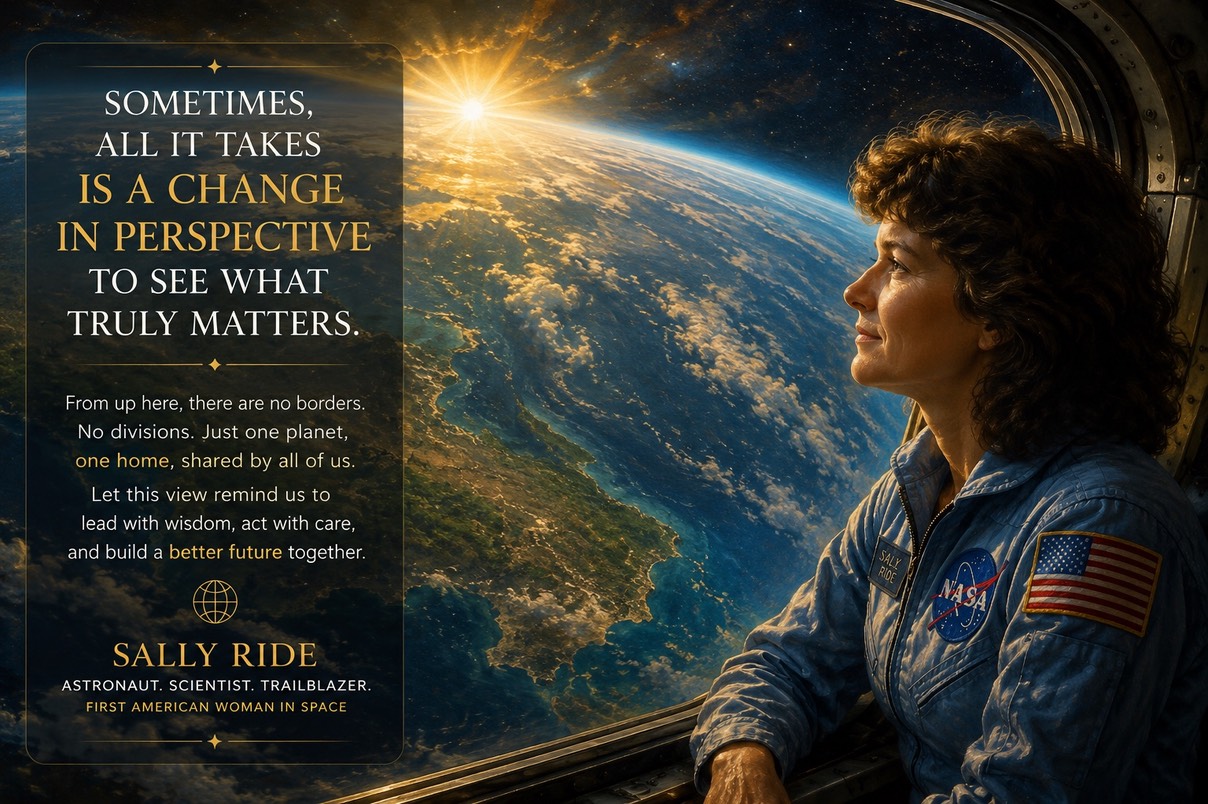
Sanjay Kumar Mohindroo
A single view from space can change how we think about ambition, unity, and our place on Earth
A Window Beyond Limits
A moment that changed the meaning of perspective
“The view of Earth is spectacular.” — Sally Ride
Simple words. Massive meaning.
Those six words carry more weight today than ever before.
When Sally Ride looked down at Earth from space, she did not just see oceans, clouds, and land. She saw a planet without borders. A place where human conflict looked small. A place where ego lost its value. A place where progress, science, and courage came together in one frame.
That view matters.
Because most people spend their lives trapped inside small circles. Small fears. Small arguments. Small goals. We obsess over status, titles, traffic, deadlines, and online noise. Then someone leaves Earth for a brief moment and comes back with a truth that cuts through all of it.
Perspective changes everything.
The farther we step back, the clearer life becomes.
#SpaceExploration is not only about rockets and machines. It is about human growth. It forces us to face a hard fact: Earth is fragile, shared, and deeply connected.
A Planet Without Divides
Distance exposes the illusion of separation
From space, there are no political lines.
No nations.
No class systems.
No social labels.
Only one living planet floating in silence.
That reality should humble every leader, company, and institution.
Yet human systems still run on division. We fight over land while standing on a tiny sphere inside an endless universe. We speak about power as if it lasts forever. We build walls while climate risks, health crises, and technology risks cross every border with ease.
This is the lesson hidden inside Sally Ride’s words.
A broader view destroys narrow thinking.
Great leadership works the same way.
The best leaders are not trapped in short-term wins. They see systems, patterns, and long-term impact. They think beyond quarterly numbers. Beyond personal credit. Beyond political cycles.
That is where real progress begins.
#Leadership and #Innovation both depend on perspective.
The people shaping the future are often the people willing to zoom out farther than everyone else.
Science With Human Meaning
Curiosity built the bridge between Earth and space
Space missions are often discussed through budgets, hardware, and national pride.
That misses the deeper point.
Every major leap in science started with curiosity. Someone looked at the sky and asked a bigger question. Someone refused to accept limits set by the present moment.
Sally Ride represented that mindset.
She became the first American woman in space during a time when science and aerospace were still heavily male-dominated. She entered rooms where few women were expected to lead. She proved that capability matters more than stereotypes.
That legacy still matters in #STEM, #Education, and #WomenInScience.
Talent exists everywhere. Opportunity does not.
The future gets stronger when more people are allowed to contribute to it.
This applies far beyond space programs.
Companies stagnate when they hire the same mindset repeatedly. Nations weaken when they ignore talent because of background, gender, or class. Innovation slows when curiosity is replaced by gatekeeping.
Progress requires open doors.
It also requires courage.
Because every breakthrough looks impossible before it becomes normal.
The Scale of Human Potential
Small human-built machines that touched the stars
Think about the scale of this achievement.
Human beings once feared crossing oceans.
Then we crossed continents.
Then we flew through the air.
Then we walked on the Moon.
Every generation inherits limits and then breaks some of them.
That should inspire optimism.
Not blind optimism. Not fantasy.
Grounded optimism.
Humanity has flaws. Serious ones. But humans also built medicine, satellites, clean water systems, global communication networks, and space telescopes capable of seeing billions of light-years away.
That matters.
It proves progress is possible when knowledge, discipline, and ambition work together.
#Technology becomes meaningful when it expands human potential instead of shrinking human thought.
This is where modern society faces a serious test.
Technology today gives people endless information but very little perspective. People know every minor controversy within minutes, yet many rarely stop to think about humanity’s larger direction.
Space reminds us to think bigger.
Not just economically.
Civilizationally.
A Reminder of Responsibility
Beauty also carries warning signs
The view of Earth is beautiful because it is rare.
There is no replacement waiting somewhere nearby.
No backup civilization.
No second Earth is ready for transfer.
That reality should sharpen global priorities.
Environmental damage is not an abstract debate anymore. Water stress, rising temperatures, and pollution already affect economies, migration, food systems, and public health.
The irony is clear.
Humans reached space through brilliance, yet often struggle to protect the planet beneath them.
Perspective without action means nothing.
Admiring Earth must lead to responsibility toward Earth.
That includes governments, industries, and individuals.
#ClimateAction is not about political branding. It is about long-term survival and stability.
The same species capable of reaching orbit should also be capable of protecting forests, oceans, and clean air.
Anything less is a failure of priorities.
A Final Look Upward
Perspective remains humanity’s greatest tool
Sally Ride’s quote survives because it touches something timeless inside people.
Wonder.
Not childish wonder. Mature wonder.
The kind that reminds adults they are part of something larger than daily routines and endless noise.
Those feelings matter.
It pushes scientists to experiment.
It pushes explorers to travel.
It pushes entrepreneurs to build.
It pushes young students to believe that impossible things may become real during their lifetime.
The future belongs to people who keep looking upward while staying grounded in responsibility.
Earth is spectacular.
Not because it is perfect.
Because it is home.
And because against impossible odds, conscious life emerged here and learned to look back at itself from the stars.
That should never stop inspiring us.
#SpaceExploration #Leadership #Innovation #STEM #Education #WomenInScience #Technology #ClimateAction
Sally Ride was the first American woman in space. She was also a physicist, educator, and strong advocate for science education and young learners in STEM fields.
Light After Ruin.

Sanjay Kumar Mohindroo
The Quiet Power That Rebuilds Everything
Even broken seasons carry the seed of strength, purpose, and a return to light.
“Faith is the strength by which a shattered
world shall emerge into the light.”
— Helen Keller
This is not a soft quote. It is not blind hope. It is not wishful thinking.
It is a hard truth about survival.
Every person reaches a season where things break. Careers collapse. Trust fades. Families drift apart. Health changes. Nations struggle. Systems fail. The image people built of their lives no longer matches reality.
That moment changes people.
Some become bitter. Some go numb. Some spend years blaming the darkness. But some decide to carry a belief even when there is no proof ahead. That choice changes everything.
That is the real force behind #Leadership, #Growth, and lasting progress.
Most people think strength looks loud. They picture power, money, titles, status, and certainty. Real strength often looks nothing like that.
Real strength is waking up after loss and still choosing effort.
Real strength is building again after failure.
Real strength is refusing to let pain become your full identity.
That kind of belief creates movement.
Broken Ground
The Weight That Tests Every Person
Modern life rewards appearance. Social media rewards polished victories. Companies celebrate outcomes. Society notices winners.
Very few people talk honestly about the years before success.
The silent years matter more.
The failed business.
The rejected application.
The lonely phase.
The unpaid effort.
The self-doubt nobody saw.
This is where people either shrink or sharpen.
Many talented people never fail because they stop trying too early. Fear freezes them. They wait for certainty before action. That certainty never comes.
The people who rise are rarely untouched by struggle. They simply refuse to stay buried under it.
This matters in business, public service, relationships, and personal growth.
Every strong institution carries scars. Every respected leader has survived pressure. Every meaningful mission faces resistance.
Nothing valuable is built without strain.
That is why #Mindset matters more than motivation.
Motivation changes daily. Belief stays during chaos.
The Quiet Engine
Faith Beyond Religion
Many people hear the word “faith” and reduce it to religion alone. The deeper meaning is broader.
Faith is trust in purpose before results appear.
A founder has faith before revenue arrives.
A student has faith before results come out.
A nation has faith before reforms show impact.
A patient has faith before recovery begins.
Without belief, effort dies early.
This is visible across history. Breakthroughs came from people who kept moving while others mocked them, ignored them, or doubted them.
That is true in science.
That is true in policy.
That is true in innovation.
That is true in art.
Every major shift begins as an unpopular conviction.
The hard part is not starting. The hard part is continuing when progress feels invisible.
That is where character forms.
The strongest professionals are not the smartest in the room every time. They are often the people who stay steady under pressure. They kept learning. They adapted. They rebuilt after setbacks.
That is the foundation of #Success and #Purpose.
The Human Edge
Strength That Cannot Be Automated
We are entering a period shaped by AI, automation, and constant disruption. Skills will change faster than ever. Entire industries will shift.
But one thing remains deeply human.
The ability to endure hardship without losing direction.
Machines can process data. They cannot replace conviction.
They cannot replace courage.
They cannot replace moral clarity.
Human progress still depends on people who can stand inside uncertainty and keep building.
That is why emotional strength is becoming a competitive edge.
Teams need it. Families need it. Countries need it.
A person who can stay calm during failure becomes valuable everywhere.
This is also why #Resilience should never be treated as a trendy word. It is practical. It affects decision-making, leadership quality, team culture, and long-term growth.
Weak people chase comfort first. Strong people chase meaning first.
Comfort fades quickly. Meaning lasts.
A Better Measure
The Standard Worth Respecting
Many people measure life through visible wins alone.
Salary.
Followers.
Titles.
Status.
Those things are fine. But they are incomplete.
A better measure exists.
Can you keep your integrity under pressure?
Can you remain kind without becoming weak?
Can you keep moving after disappointment?
Can you create light for others during hard times?
That is the test.
The people remembered most are rarely those who lived easy lives. They are the people who gave others strength when darkness felt heavy.
That is why certain leaders, teachers, parents, writers, and builders remain unforgettable.
They became proof that pain does not need the final word.
That message matters deeply today.
Many people feel exhausted, isolated, and uncertain about the future. They need honesty more than fake positivity. They need reminders that setbacks are not permanent identities.
A rough chapter is not the whole story.
The people who rebuild themselves often become stronger than before.
That is the strange power hidden inside hardship.
The Return to Light
The Choice That Changes Everything
Every difficult season asks the same question:
Will this break you, or will this build you?
No motivational speech can answer that for someone. No book can fully answer it either.
The answer comes from daily choices.
Keep showing up.
Keep learning.
Keep building.
Keep believing there is still meaning ahead.
That is not a weakness. That is discipline.
And over time, disciplined belief changes lives.
The future does not belong to people who never
struggled.
It belongs to people who refused to stay defeated.
That is the deeper truth behind Helen Keller’s words.
She did not speak from comfort. She spoke from experience.
And that is exactly why her message still carries weight today.
Helen Keller was an American author, educator, and disability rights advocate who became one of the most respected voices of courage and human determination despite being deaf and blind from early childhood.
#Leadership #Growth #Mindset #Success #Purpose #Resilience
Helen Keller was an American author, educator, and
activist who overcame the challenges of being deaf and blind from a young age.
With the help of her teacher, Anne Sullivan, she learned to communicate
and became an inspiration to millions around the world. Helen Keller dedicated
her life to promoting education, equality, and opportunities for people with
disabilities.
A Life Complete in Quiet Corners.
Sanjay Kumar Mohindroo
A reflective take on simplicity, knowledge, and fulfillment through Cicero’s timeless idea.
There is a quiet kind of wealth that does not show up in bank accounts or public praise. It sits in still moments, in the space between thought and action. As Marcus Tullius Cicero once said, "If you have a garden and a library, you have everything you need."
This line carries a calm certainty. It suggests that a life built on growth and understanding is already complete. A garden speaks of care, patience, and connection to the physical world. A library represents ideas, reflection, and the endless expansion of the mind. Together, they form a balanced life that does not depend on excess, noise, or constant motion. This article moves through that idea, stretching it, questioning it, and grounding it in today’s reality.
The Garden Within Reach
Growth, patience, and the discipline of care
A garden is not just soil and plants. It is a daily commitment to nurturing something that cannot be rushed. You plant, you wait, and you trust the process. That rhythm builds patience in a way no shortcut can offer. In a world chasing instant results, the garden stands as quiet resistance.
It also teaches control and surrender at the same time. You can water, prune, and protect, but you cannot force growth. That balance shapes a grounded mindset. It keeps a person steady even when life moves out of control. The garden becomes a teacher, not just a space.
The Library of Thought
Ideas as tools for clarity and direction
A library holds more than books. It holds perspective. Each page adds a layer to how you see the world and your place in it. When you read, you borrow wisdom across time. You sit with thinkers, leaders, and creators who faced their own struggles.
This builds a strong internal compass. It sharpens judgement and expands empathy. A person with access to ideas rarely feels trapped by one way of thinking. The library becomes a space where confusion turns into clarity. It gives language to thoughts that once felt vague.
A Balance That Grounds Modern Life
Simple anchors in a distracted world
Today’s life is loud and crowded with constant updates. Attention is pulled in every direction. In this chaos, the idea of a garden and a library feels almost radical. It calls for stillness and focus.
These two spaces create anchors. One keeps you rooted in the present. The other pushes you to think beyond it. Together, they prevent both stagnation and distraction. This balance is rare, yet deeply needed.
The idea also challenges modern definitions of success. It questions whether more always means better. It reminds us that depth often matters more than scale.
Challenging the Idea
Is simplicity enough in a complex world?
The quote can feel idealistic. Life demands income, relationships, and responsibilities that go far beyond a garden and a library. Yet the value lies in what they represent, not just what they are.
They stand for self-sufficiency and inner richness. They suggest that external achievements lose meaning without internal stability. The message is not to reject ambition, but to anchor it. Without grounding, success feels hollow. With grounding, even small wins feel complete.
A fulfilled life is not built on constant accumulation. It is shaped by what you nurture and what you understand. The garden keeps you connected to effort and patience. The library keeps you connected to thought and perspective.
Together, they offer something rare: a sense of enough. And in a world that always asks for more, that sense is powerful.
#SimpleLiving #PersonalGrowth #MindfulLiving #Knowledge #Wisdom #BalancedLife #Philosophy #Clarity #SelfDevelopment
Marcus Tullius Cicero was a Roman statesman, philosopher, and writer known for his influence on Western thought. His work shaped ideas on politics, ethics, and rhetoric. His reflections on life continue to resonate because they speak to human nature with clarity and depth.
The Silent Language Written Across the Night Sky

Sanjay Kumar Mohindroo
A reflective take on how the night sky mirrors human emotion, meaning, and imagination.
“Ye stars! Which are the poetry of heaven! - Lord Byron.”
There is something deeply human about looking up at the night sky and feeling understood. This line captures more than beauty. It speaks to a quiet connection between the universe and the human mind. The stars are not just objects burning in distant space. They feel like words, carefully placed across the sky, forming a language that does not need translation.
The emotion behind this thought is both wonder and recognition. It suggests that the universe is not silent. It communicates, not through sound, but through presence. This idea opens a path to reflect on how we interpret meaning, where we find comfort, and why we often look upward when searching for answers.
The Sky as a Living Canvas
Where imagination meets observation
The night sky has always been more than a scientific field of study. It has been a space for stories, myths, and personal reflection. When people see stars, they do not just see light. They see patterns, memories, and possibilities. This is where the idea of “poetry” becomes powerful.
Poetry does not exist to explain everything. It exists to evoke feeling. In the same way, the stars do not provide direct answers. They invite interpretation. This is why ancient civilizations mapped constellations and gave them names. It was never just about navigation. It was about making sense of existence.
In modern times, this connection still holds. Even with all our data and technology, the emotional response remains unchanged. A clear night sky still has the power to pause a busy mind.
Meaning Beyond Logic
When facts are not enough
There is a limit to what facts can offer. They explain the “how” but rarely satisfy the “why.” This is where symbolic thinking steps in. When someone sees stars as poetry, they are choosing to experience life beyond measurable facts.
This is not about rejecting science. It is about accepting that human experience includes emotion, curiosity, and imagination. These elements give depth to our lives. Without them, everything becomes mechanical.
Seeing meaning in the sky reflects a mindset. It shows a willingness to engage with life in a richer way. It encourages people to pause, reflect, and feel. This is where personal growth often begins.
The Human Need to Connect
Searching for patterns and purpose
People are wired to look for connections. It is how we understand the world. The stars offer a perfect surface for this instinct. They are distant, yet visible. Silent, yet expressive.
When someone feels overwhelmed or uncertain, the sky often becomes a place of calm. It creates perspective. Problems that feel large begin to shrink. This is not because they disappear, but because the mind shifts its frame.
This connection also explains why moments under the stars often feel personal. They create space for introspection. They remind people that they are part of something larger, without making them feel insignificant.
A Quiet Form of Motivation
Inspiration without instruction
There is no direct message written in the sky, yet people walk away inspired. This is the power of subtle influence. The stars do not tell anyone what to do. They simply exist, consistent and present.
This quiet consistency can be grounding. It reminds people that not everything needs to be rushed or forced. Some things unfold over time. Some meanings reveal themselves only when one slows down.
In a time filled with noise and constant input, this kind of silent inspiration is rare. It encourages clarity. It supports focus. It builds a sense of calm confidence.
The idea of stars as poetry is not just about beauty. It is about perception. It shows that meaning is not always given. It is often created. The sky becomes a mirror for the mind, reflecting whatever one is willing to see.
This perspective invites a shift. It asks people to move beyond surface-level thinking and engage with life more deeply. It encourages awareness, patience, and imagination.
The next time the night sky stretches above, it will still be the same. The difference will be in how it is seen. That is where its true power lies.
#Stars #NightSky #HumanPerception #PoetryOfLife #Mindset #Reflection #Inspiration #EmotionalDepth
Lord Byron was a leading figure in the Romantic movement, known for his expressive and emotional poetry. His work often explored nature, beauty, and the human spirit. His perspective continues to influence how people interpret emotion and meaning in the natural world.
Listening Beyond Noise.
Sanjay Kumar Mohindroo
The Quiet Intelligence Within Us
A reflective take on inner awareness, intuition, and the unseen signals guiding human life.
“We have the capacity to receive messages from the stars and the songs of the night winds.” — Ruth St. Denis.
This line carries a quiet power. It suggests that human perception is not limited to what is visible or measurable. There is a deeper channel within us that listens, senses, and understands without words. It speaks to intuition, awareness, and a form of intelligence that operates beneath logic. In a time filled with constant noise, this idea feels almost radical. It asks a simple but uncomfortable question. Are we still listening?
The Forgotten Skill of Inner Listening
Noise Has Replaced Awareness
Modern life rewards speed and reaction. We are trained to respond fast, speak quickly, and stay visible. In that rush, the ability to pause and listen inward fades. Inner listening is not passive. It requires attention and honesty. It asks us to sit with thoughts without rushing to label them.
When we ignore this skill, we begin to depend only on external validation. Decisions become louder but not wiser. The mind becomes crowded, and clarity slips away. The idea of hearing something as subtle as a “night wind” feels distant. Yet that subtle signal often carries more truth than constant chatter.
Intuition Is Not a Mystery, It Is a Pattern
Experience Speaks in Silence
People often treat intuition as something mystical. In reality, it is built over time. It is the brain processing patterns faster than conscious thought. Every experience, every mistake, and every success feeds it. When it speaks, it does not argue. It nudges.
Ignoring intuition is easy because it rarely demands attention. It does not compete with urgency. Yet those who trust it often make decisions that feel right long before they can explain them. This quiet signal is not random. It is earned.
The Courage to Trust What You Cannot Prove
Clarity Often Arrives Without Evidence
There is a risk in trusting what cannot be measured. It goes against structured thinking and external proof. Yet many defining choices in life come from this space. Career shifts, creative work, and personal relationships often begin with a feeling, not a spreadsheet.
Trusting that feeling does not mean abandoning logic. It means allowing both to exist. Logic validates. Intuition initiates. When used together, they create decisions that are both sound and aligned.
Reclaiming Attention in a Distracted World
Awareness is a Choice, not a Luxury
Attention is constantly being pulled outward. Notifications, opinions, and endless content leave little space for reflection. Reclaiming attention is not about escape. It is about control.
Moments of silence, even brief ones, reset the mind. They create room for clarity. Over time, this practice strengthens awareness. The signals that once felt distant begin to feel familiar. The “messages” are not coming from somewhere else. They were always within reach.
The ability to sense beyond the obvious is not rare. It is simply neglected. When we slow down and listen, we begin to notice patterns, feelings, and insights that guide us with surprising accuracy. The world may reward noise, but clarity comes from stillness. The real shift is not in the environment. It is in our willingness to pay attention.
#intuition #selfawareness #mindfulness #clarity #personalgrowth #innervoice #focus #awareness
Ruth St. Denis was a pioneer of modern dance in the early twentieth century. She explored spiritual expression through movement and art. Her work often blended Eastern philosophy with Western performance, making her voice deeply reflective and experiential.
Echoes Beneath the Surface

Sanjay K Mohindroo
The Silence That Speaks.
A reflective take on memory, consequence, and the quiet weight of history beneath life’s surface.
Something is unsettling about the sea. It looks calm, endless, almost forgiving. Yet beneath that surface lies a depth we rarely confront. As Thomas Bailey Aldrich once wrote, "The ocean moans over dead men's bones."
The line carries a quiet gravity. It speaks of memory, of consequence, and of the stories that never fully disappear. It reminds us that no matter how far we move forward, the past remains. Not loudly, not visibly, but persistently. This idea is not just about the ocean. It reflects how life carries echoes of everything that has come before.
The Weight Beneath Calm Waters
Peace Often Hides Untold Stories
On the surface, life often appears stable and controlled. We present calm versions of ourselves, polished and composed. Yet beneath that calm lies a history of choices, struggles, and moments that shaped us.
The ocean becomes a metaphor for human experience. It does not erase what it holds. It carries it, absorbs it, and lets it exist in silence. In the same way, people carry their past. Every success, failure, regret, and lesson remains part of who they are.
This perspective challenges the idea that time erases everything. It does not. Time softens edges, but it does not remove the core. The past continues to influence the present, quietly guiding decisions and shaping perspective.
Memory Does Not Fade, It Transforms
The Past Changes Form, Not Presence
There is a belief that moving on means leaving things behind. That is rarely true. What actually happens is a transformation. Pain becomes understanding. Mistakes become insight. Loss becomes depth.
The ocean does not return what it takes, but it changes it. What was once visible becomes part of a larger system. In the same way, human memory shifts from sharp emotion to quiet awareness.
This shift is powerful. It allows growth without denial. It creates a form of strength that is not loud but steady. When we accept that our past stays with us, we stop running from it. We begin to use it.
This is where real personal growth happens. Not in forgetting, but in integration.
Silence Carries Its Own Voice
Absence Can Speak Louder Than Words
The idea of the ocean “moaning” suggests something more than sound. It points to a feeling, a presence, a reminder that something exists even when unseen.
Silence is often misunderstood as emptiness. In reality, it holds meaning. The quiet moments in life carry reflection, clarity, and sometimes discomfort. They force us to face what we usually avoid.
In leadership, in relationships, and in personal growth, silence reveals truth. It strips away distraction and leaves only what matters. Many people avoid it, but those who embrace it gain clarity that others miss.
This is where depth is built. Not in constant noise, but in moments of stillness.
Living With Awareness, Not Escape
Growth Comes from Acknowledgment, Not Avoidance
There is a strong urge to move forward without looking back. It feels efficient and clean. But it often leads to repetition of the same mistakes.
Acknowledging the past does not weaken a person. It strengthens them. It builds awareness, which is the foundation of better decisions.
The ocean does not deny what lies beneath it. It exists with it. That acceptance gives it power, not weakness.
In life, the same principle applies. When we accept our history, we gain control over our direction. We stop reacting and start choosing. This shift changes everything.
The image of the ocean carrying silent remnants is not meant to disturb. It is meant to awaken awareness. Life is not about erasing what came before. It is about understanding it, carrying it with purpose, and using it to move forward with clarity.
When we accept that nothing is truly lost, we begin to see value in every experience. The past stops being a burden and becomes a foundation. And from that foundation, stronger, more thoughtful choices emerge.
#PersonalGrowth #LifeLessons #SelfAwareness #Reflection #Mindset #EmotionalDepth #InnerStrength
Thomas Bailey Aldrich was a 19th-century American writer known for his poetry and reflective prose. His work often explored themes of memory, time, and human experience. His writing continues to resonate because it captures deep truths in simple, powerful language.